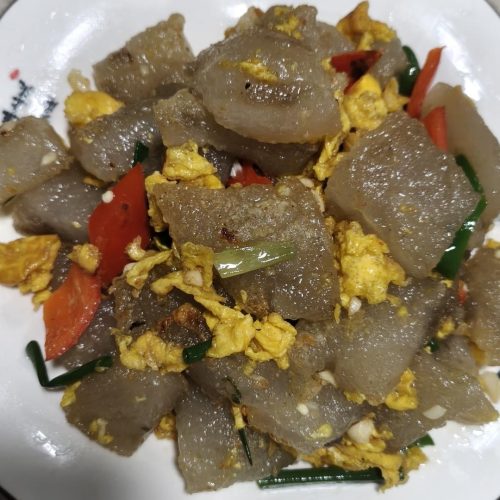
Some dishes earn their place at the table because they are elegant, and some earn it because they are deeply, almost stubbornly satisfying. This stir-fried sweet potato starch with eggs belongs firmly in the second group. Chewy slabs of starch cake, golden scrambled egg, garlic, and sweet pepper all tumble together in a hot wok until every piece is glossy, savory, and just a little springy under your teeth. It is the kind of thing that shows up on a Hunan or Hubei family table on a weeknight, and it is the kind of thing you will find yourself craving again a few days later.
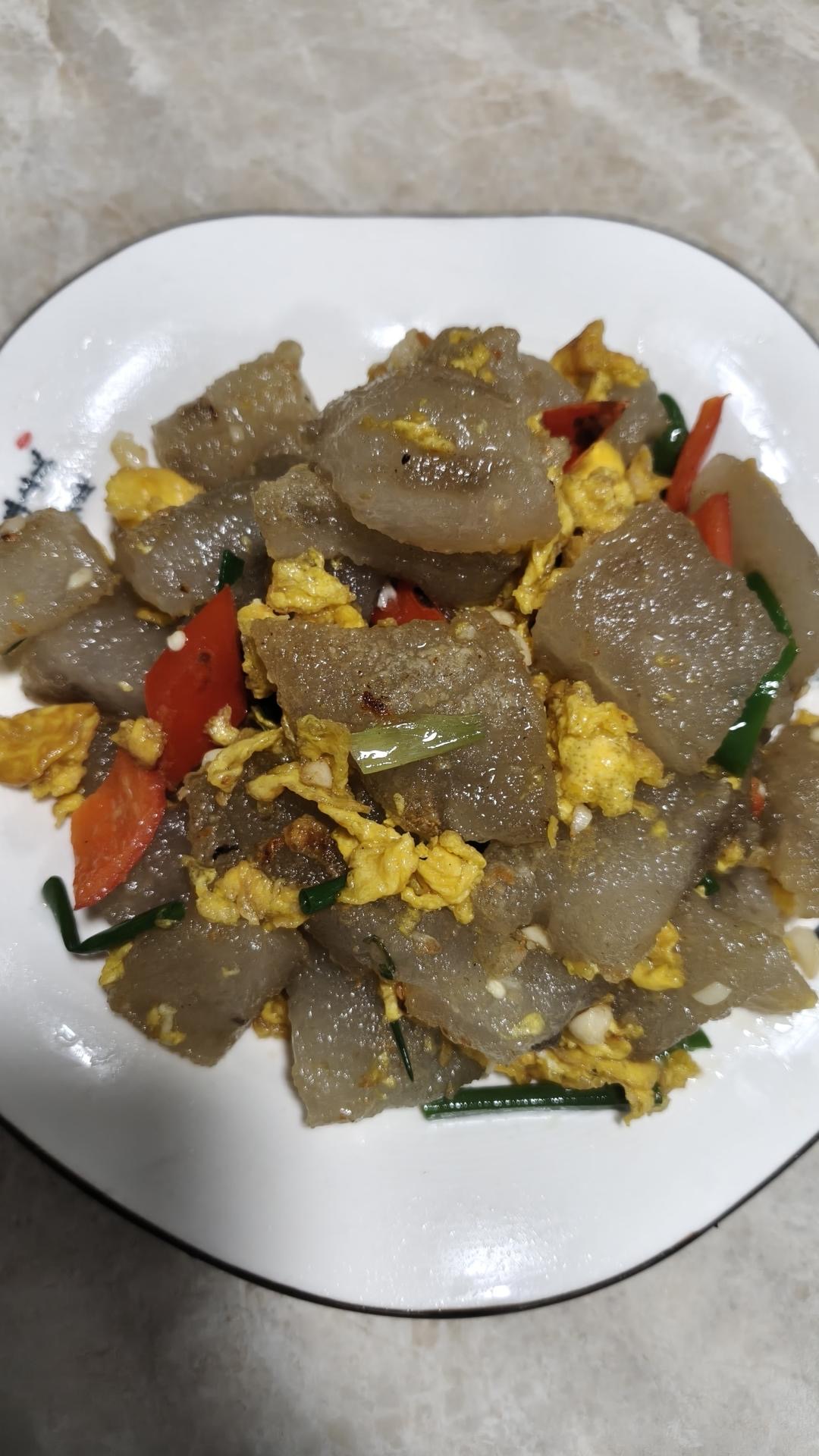
The first time you make it, the starch will feel strange — a bowl of cloudy water that you are supposed to leave alone for hours. Trust the process. That long soak is the whole trick, and once the starch has settled and drained, the rest of the dish moves at wok speed. You will be eating in under twenty minutes.
What Is 红薯粉炒鸡蛋?
红薯粉炒鸡蛋 — hongshufen chao jidan — is a Chinese home-style stir-fry built on sweet potato starch rather than noodles or rice. Sweet potato starch (红薯粉, hongshufen) is a fine, slightly grayish powder made from ground sweet potatoes. When it is soaked in water, allowed to settle, drained, and then fried, it turns into a firm, translucent, bouncy cake. That cake is cut into blocks, dusted with more starch, and tossed in a wok with scrambled egg, garlic, peppers, and a light seasoning of salt, chicken bouillon, and MSG.
Think of it as the chewier, more rustic cousin of a rice-noodle stir-fry. The starch itself is almost flavorless, which is exactly why it works so well: it drinks up the oil, the garlic, and the seasoning, and it gives the dish a texture you simply cannot get from noodles. In commercial kitchens it is often made in large batches because it is cheap, fast, and endlessly forgiving — but it is just as easy to make at home in a single wok.
Sweet potato starch behaves differently from cornstarch or wheat flour. When its starch granules are soaked, settled, and then heated, they gelatinize into a dense, elastic network. That is why the fried cake holds its shape when cut and stays chewy even after it is tossed with eggs and vegetables — a property food scientists describe as retrogradation, and the reason leftover starch cake is arguably even better the next day.
If you enjoy the chew of rice noodles, this dish sits in the same family. For a classic noodle version with the same wok energy, see our stir fried rice noodles, which uses the same soak-and-drain logic on dried rice noodles. If you prefer your noodles tossed with a soft fried egg on top, our pork chow mein with soft fried egg is a natural next step. And for a Cantonese-style plate of thin rice noodles with plenty of wok hei, try our fried rice noodles.
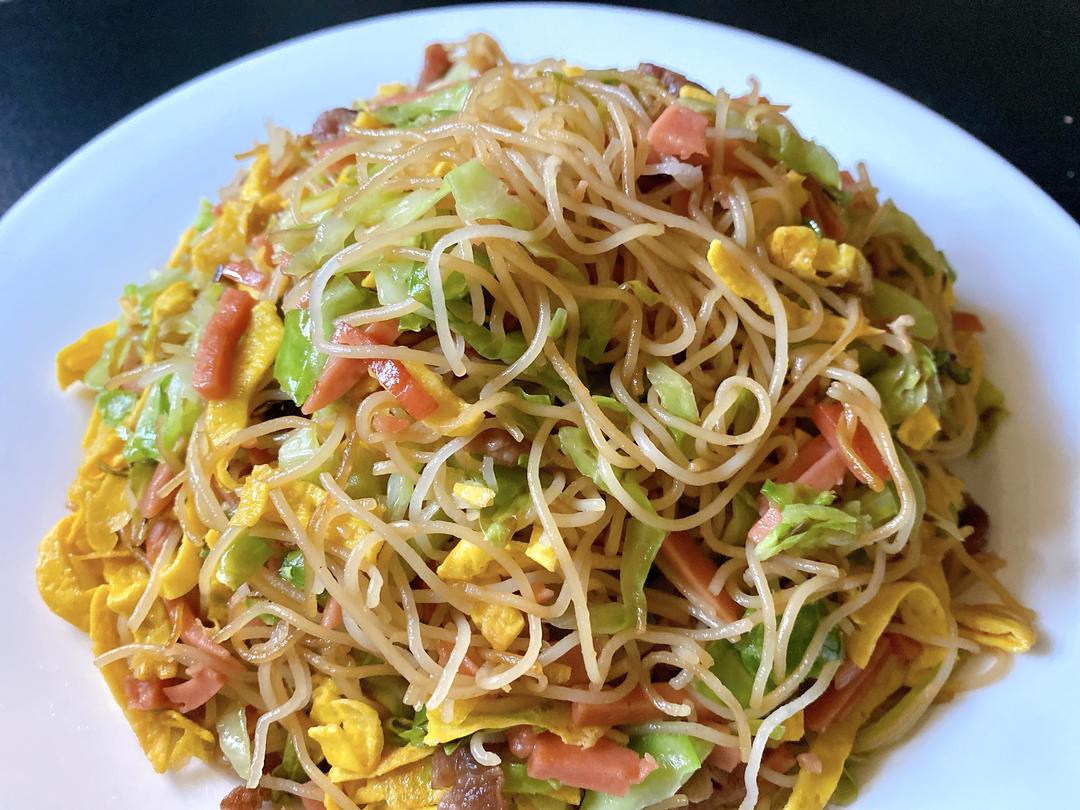
1Authentic Stir-Fried Rice Noodles (Chao Mi Fen): Chef’s SecretLearn a professional chef’s secret ‘Tan’ method for perfectly bouncy, non-mushy Authentic Stir-Fried Rice Noodles (Chao Mi Fen). An easy 25-minute weeknight dinner.Check out this recipe
Cooked this way once, you will want the next one too: pork chow mein with soft fried egg starts from the same base and the same pan.
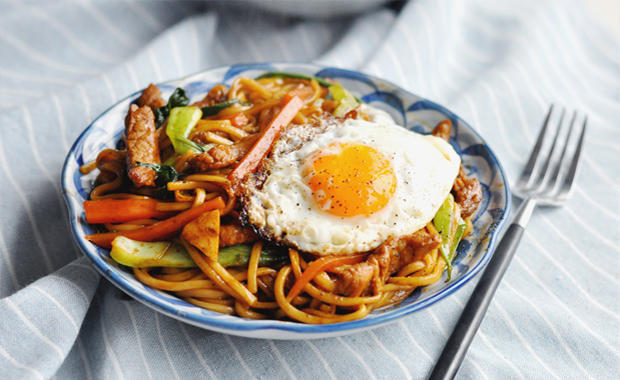
2Pork Chow Mein with Soft-Fried EggA restaurant-style Pork Chow Mein loaded with assorted vegetables and topped with a creamy, runny fried egg. The perfect satisfying noodle stir-fry for a quick dinner.Check out this recipe
For the next cook from the same playbook, fried rice noodles is the recipe I point people to.
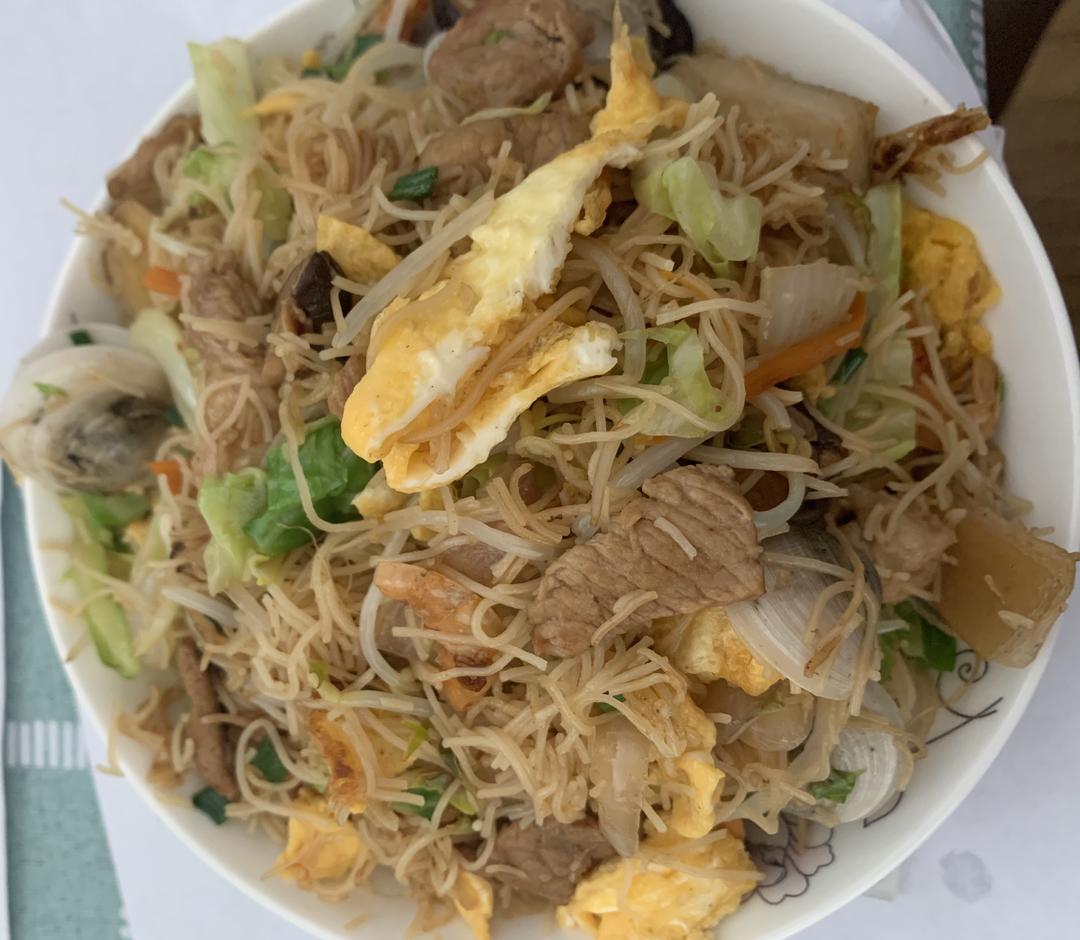
3Authentic Wenling Fried Rice Noodles (Chao Mi Mian)A classic Zhejiang breakfast street food. These delicate rice noodles are loaded with pork, dried shrimp, and vegetables, all tossed together for an umami-packed meal.Check out this recipe
Why This Recipe Works
Most home cooks who try sweet potato starch for the first time end up with a gluey, gummy mess. This recipe avoids that in three specific ways. First, the starch is soaked for at least eight hours and then fully drained, which removes the excess surface starch that causes gumminess. Second, the drained starch is fried into a single flat cake in a generous film of oil, giving it a firm, sliceable structure. Third, each cut piece is dusted with dry starch before it goes back into the wok, creating a thin barrier that keeps the cubes from welding themselves together.
The eggs are treated just as deliberately. They are beaten with no seasoning at all and scrambled first, then pushed to the side of the wok while the aromatics go in. This keeps them soft and fluffy instead of rubbery, and it means the garlic and peppers get direct contact with the hot metal. The seasoning goes in at the very end, after the starch has already been added, so the salt dissolves into the oil and coats everything evenly rather than pooling at the bottom of the pan.
Finally, the dish is seasoned with the classic commercial trio — salt, chicken bouillon powder, and MSG. You can absolutely leave the MSG out, but a small amount is what gives restaurant versions of this dish their rounded, savory depth. It is not a shortcut; it is a legitimate seasoning used in Chinese kitchens for decades.
Equipment Needed
A carbon steel or cast iron wok is the ideal vessel here because it holds heat and lets you push ingredients to the side while you work. A large skillet will also work, but keep the heat slightly lower and expect the starch to brown a bit more slowly. You will also want a wide bowl for soaking the starch, a cutting board and a sharp knife for portioning the cake, a slotted spoon or spider to shake off excess starch, and a small bowl for the beaten eggs. A flat spatula helps when you flip the starch cake, but a wide turner is fine too.
Ingredients
The ingredient list is short, but two items carry the dish: sweet potato starch and eggs. Everything else is seasoning and aromatics. Here is what you need for four servings.
- 300 g (about 0.6 lb) sweet potato starch
- 4 cups water, for soaking and settling
- 2 tablespoons neutral oil, for pan-frying the starch cake
- 3 large eggs, beaten
- 3 tablespoons neutral oil, for the wok, divided
- 3 cloves garlic, minced
- 1 small green bell pepper, cut into 1-inch pieces
- 1 small red bell pepper, cut into 1-inch pieces
- 1 teaspoon salt, or to taste
- 1/2 teaspoon chicken bouillon powder (optional)
- 1/2 teaspoon MSG (optional)
- 2 stalks scallions, cut into 2-inch sections
Ingredient Notes
Sweet potato starch (红薯粉). Look for bags labeled sweet potato starch, not sweet potato flour. They are not interchangeable. Starch is pure extracted starch and turns translucent and chewy; flour contains protein and fiber and will give you a dense, pasty result. If your bag is labeled in Chinese, you want 红薯淀粉 or 红薯粉, not 红薯面粉.
Water. Use cool tap water or filtered water. There is no need for warm water here — the starch hydrates perfectly well at room temperature, and warm water can start the gelatinization process too early.
Eggs. Three large eggs is the sweet spot for 300 g of starch. More eggs and the dish becomes an omelet with starch in it; fewer and the egg disappears into the background.
Peppers. Green and red bell peppers give color and a mild sweetness. If you want heat, swap one of them for a long hot green pepper, sliced on the bias.
Seasonings. Salt, chicken bouillon powder, and MSG are the commercial-kitchen trio. If you would rather skip the MSG, increase the chicken bouillon slightly. A tiny pinch of white pepper is a lovely addition if you have it.
Scallions. Added at the very end, off the heat or nearly so, so they stay bright green and crisp rather than wilting into the dish.
Prep & Mise en Place
Because the actual stir-fry takes under ten minutes, all the prep has to happen before the wok gets hot. Start the night before — or at least eight hours ahead — by stirring the starch into plenty of cool water in a wide bowl. Let it sit undisturbed. The starch will sink to the bottom and a clear layer of water will rise to the top.
When you are ready to cook, pour off every bit of that top water. Do not stir it back in. What remains should be a thick, dense, slightly stiff paste. Have your beaten eggs ready in a bowl, your garlic minced, your peppers cut into even 1-inch pieces, and your scallions cut into 2-inch sections. Set the salt, bouillon, and MSG within arm’s reach of the stove, because once the wok is hot you will not have time to go hunting for them.
One more piece of mise en place that most people forget: put a plate or tray near the stove for the finished starch cake, and have your slotted spoon ready for the step where you shake the excess starch off the cubes. It sounds fussy, but it is the difference between a smooth, fast stir-fry and a frantic one.
Cooking Process
Step 1 — Soak and Settle the Starch
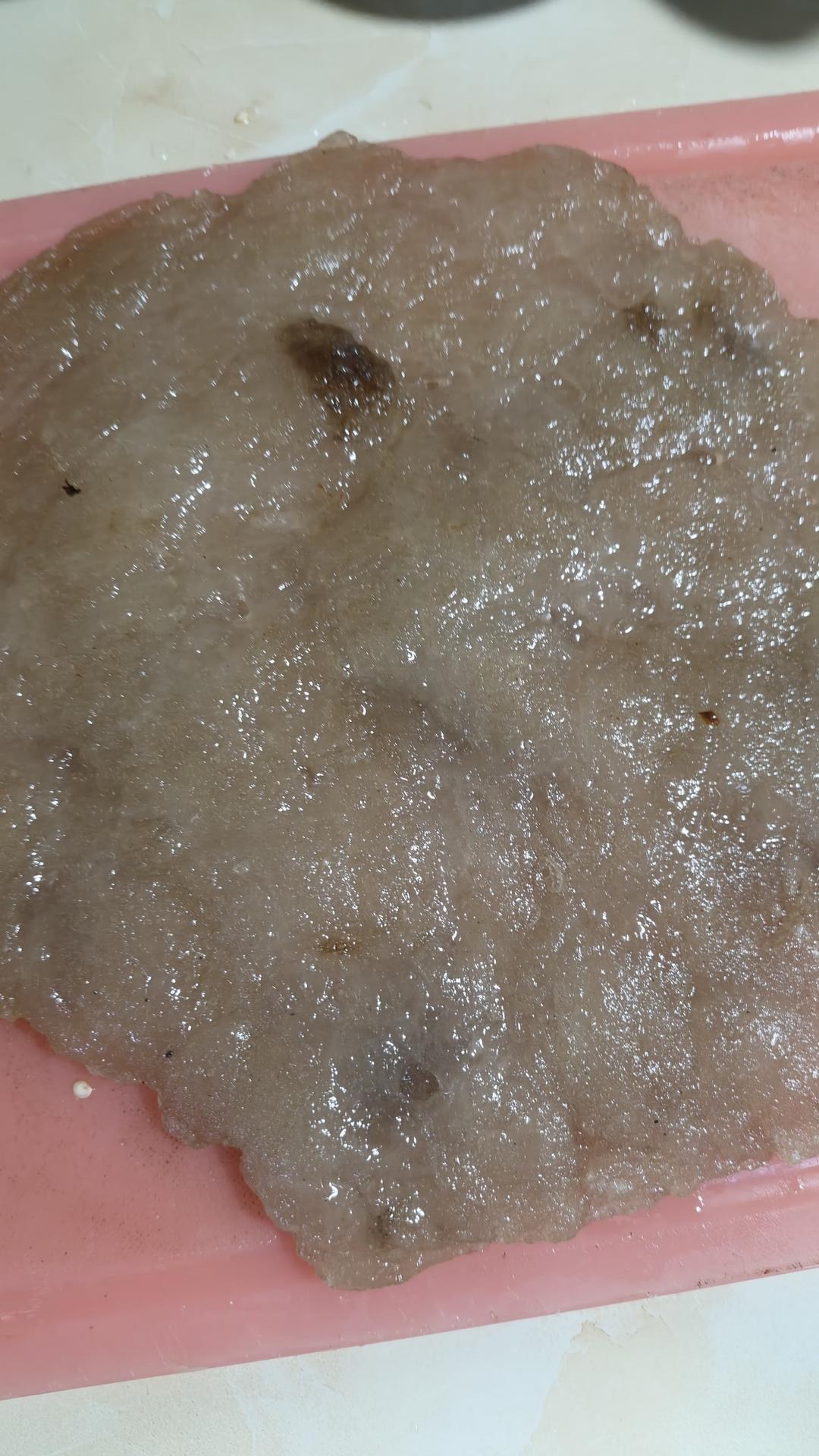
Put 0.6 jin (300 g) of sweet potato starch into a bowl, add no seasoning at all, and pour in more water than you think you need. Stir until no lumps remain, then let it settle for a good while. Once the starch has settled, pour off all the excess water on top and keep only the firm starch below, then heat salad oil in a wok and fry it into one flat cake.
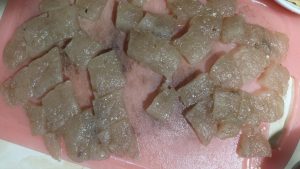
Step 2 — Cut the Cake
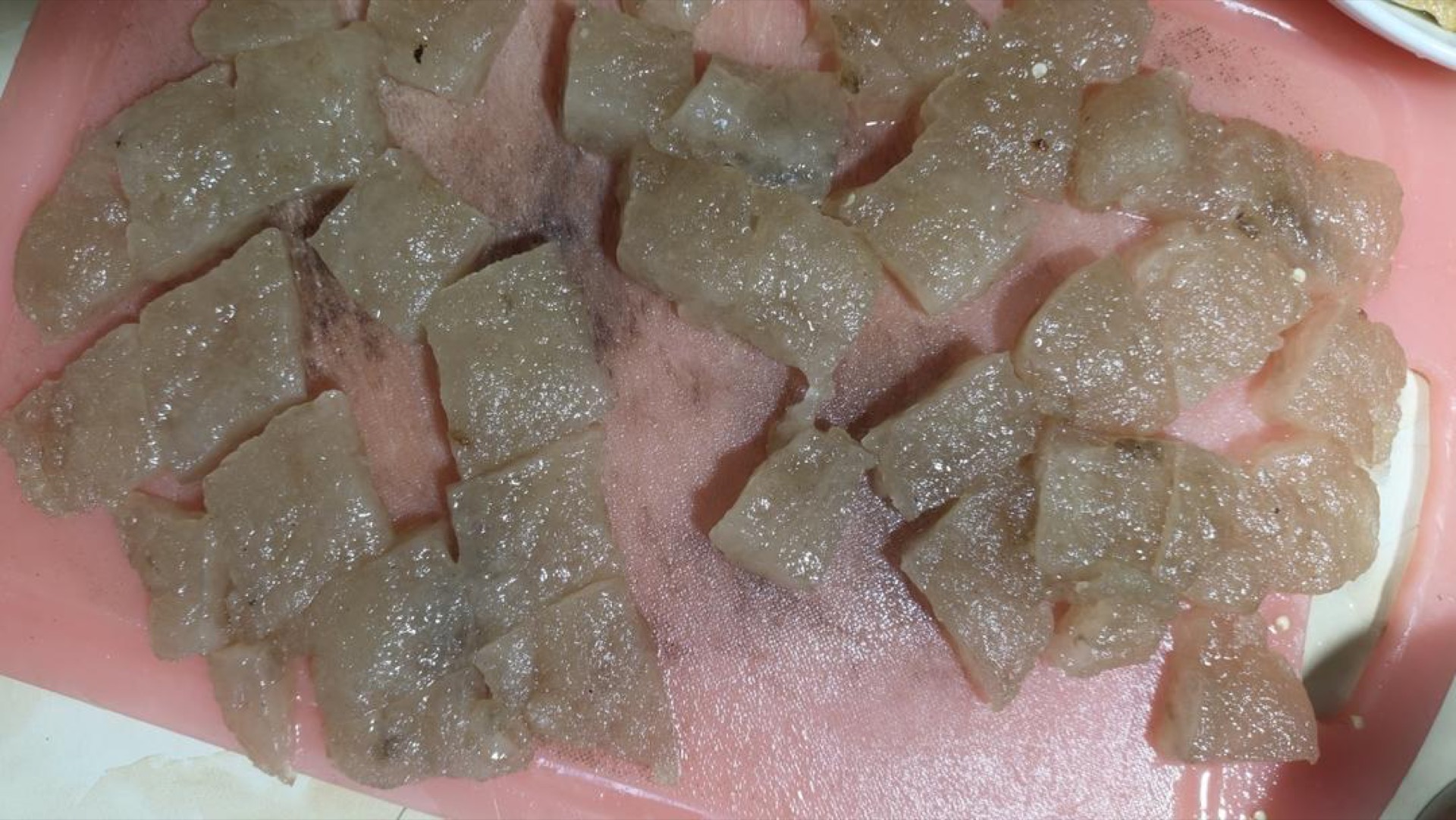
Cut the fried starch cake into bite-sized blocks.
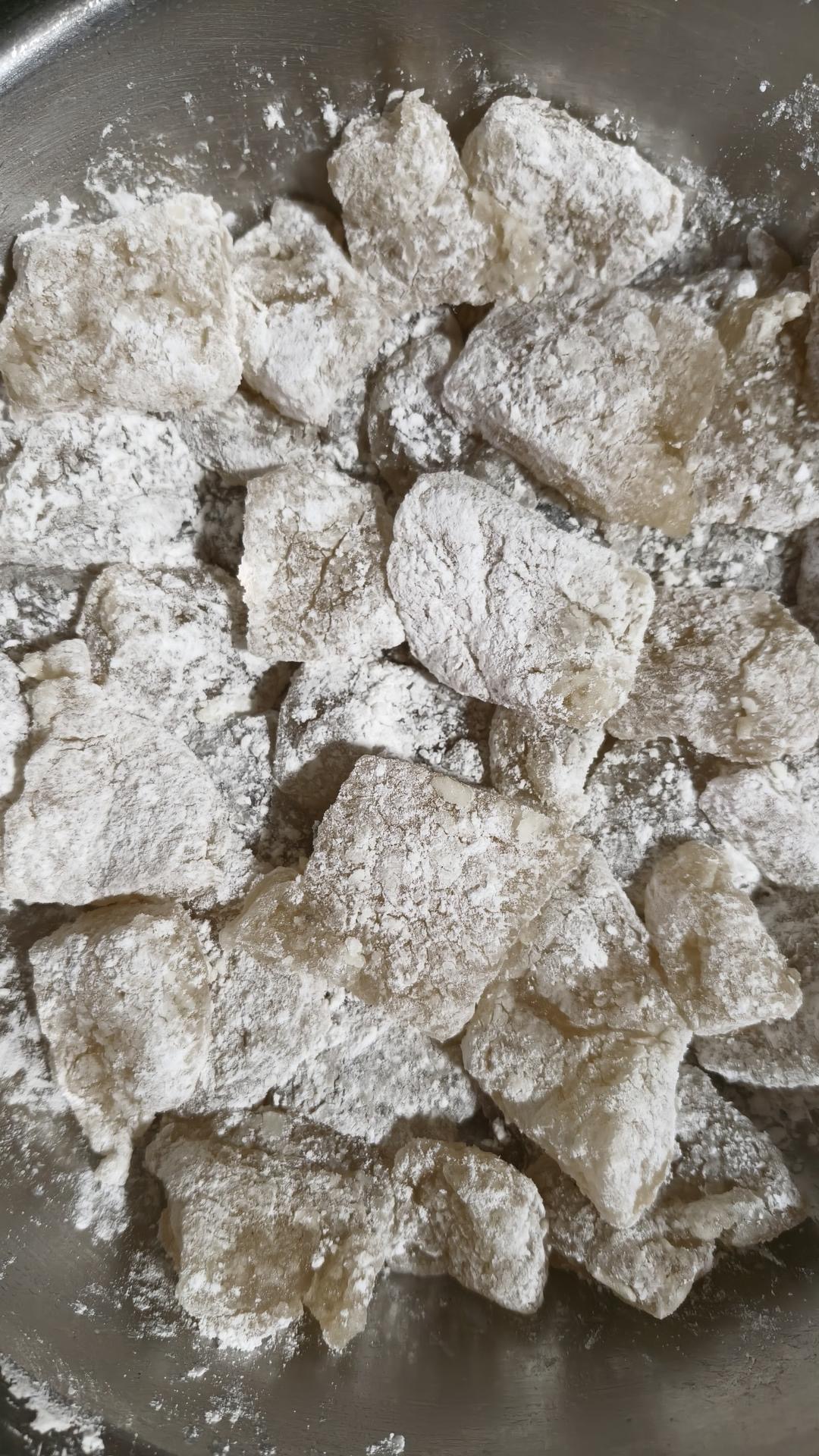
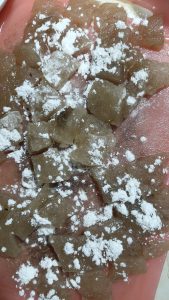
Step 3 — Dust the First Side
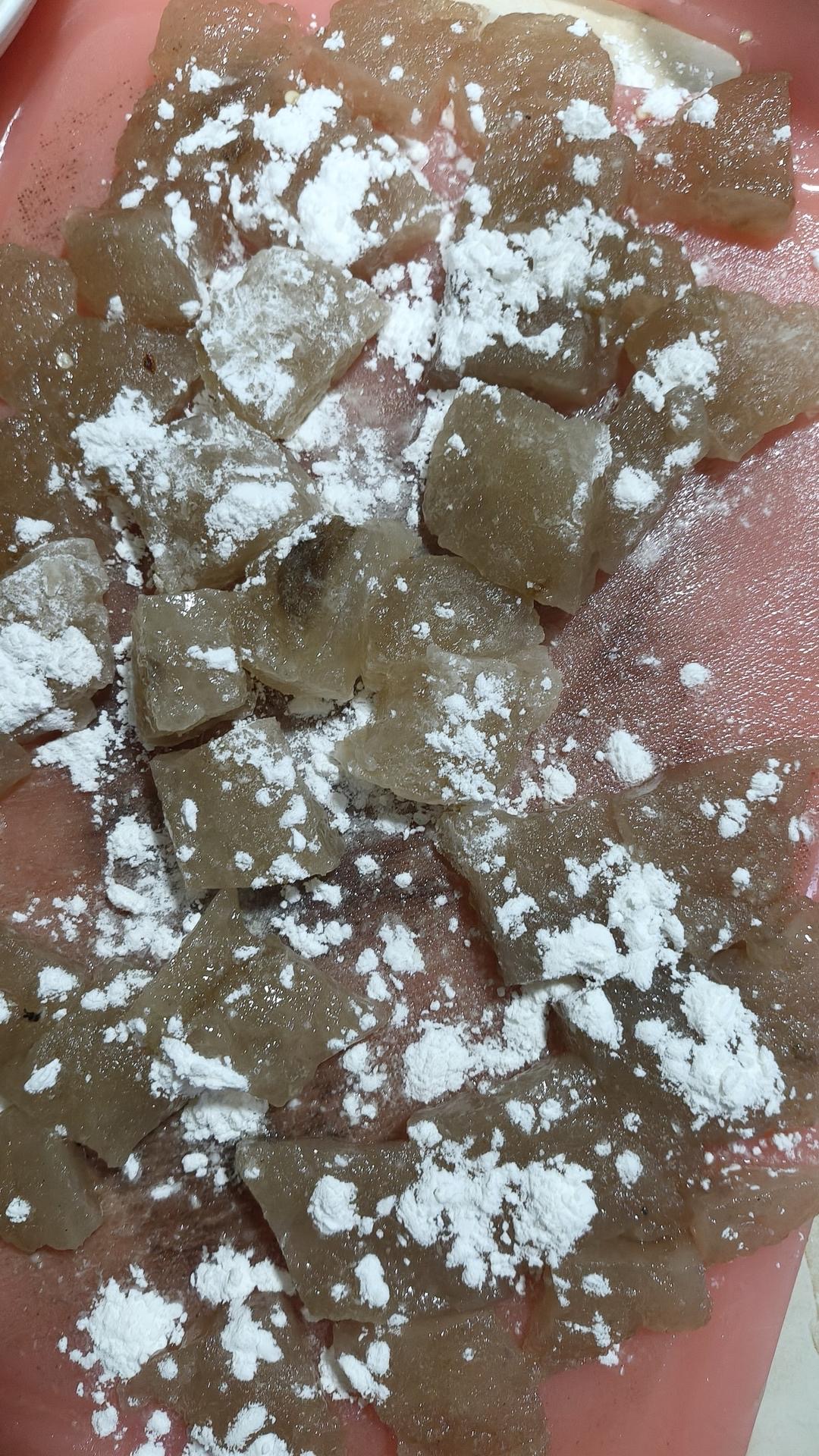
Sprinkle a little starch over the surface of the pieces.
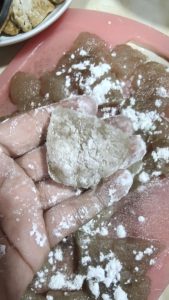
Step 4 — Coat All Sides
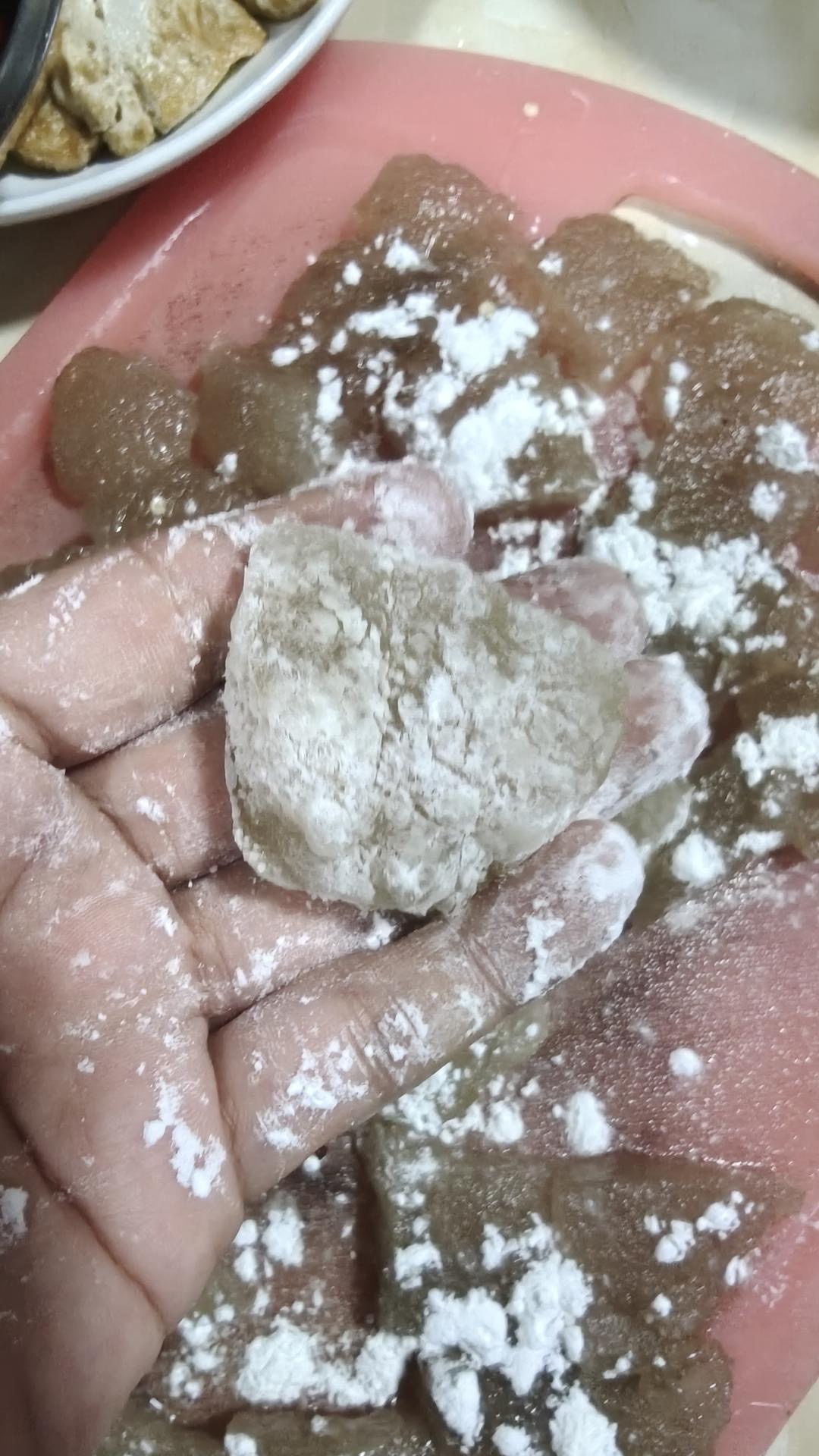
Add a bit more starch and coat each piece on all four sides, which keeps them from sticking together.
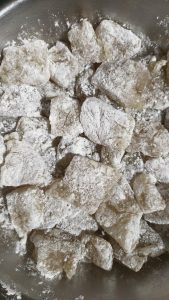
Step 5 — Finish Coating and Set Aside
Coat every single piece in starch, working one piece at a time, then put them back into the bowl and set aside.
Step 6 — Scramble the Eggs
Crack three eggs into a bowl with no seasoning needed and beat them until smooth. Heat salad oil in the wok, pour the eggs straight in, and stir-fry them until broken into soft curds.
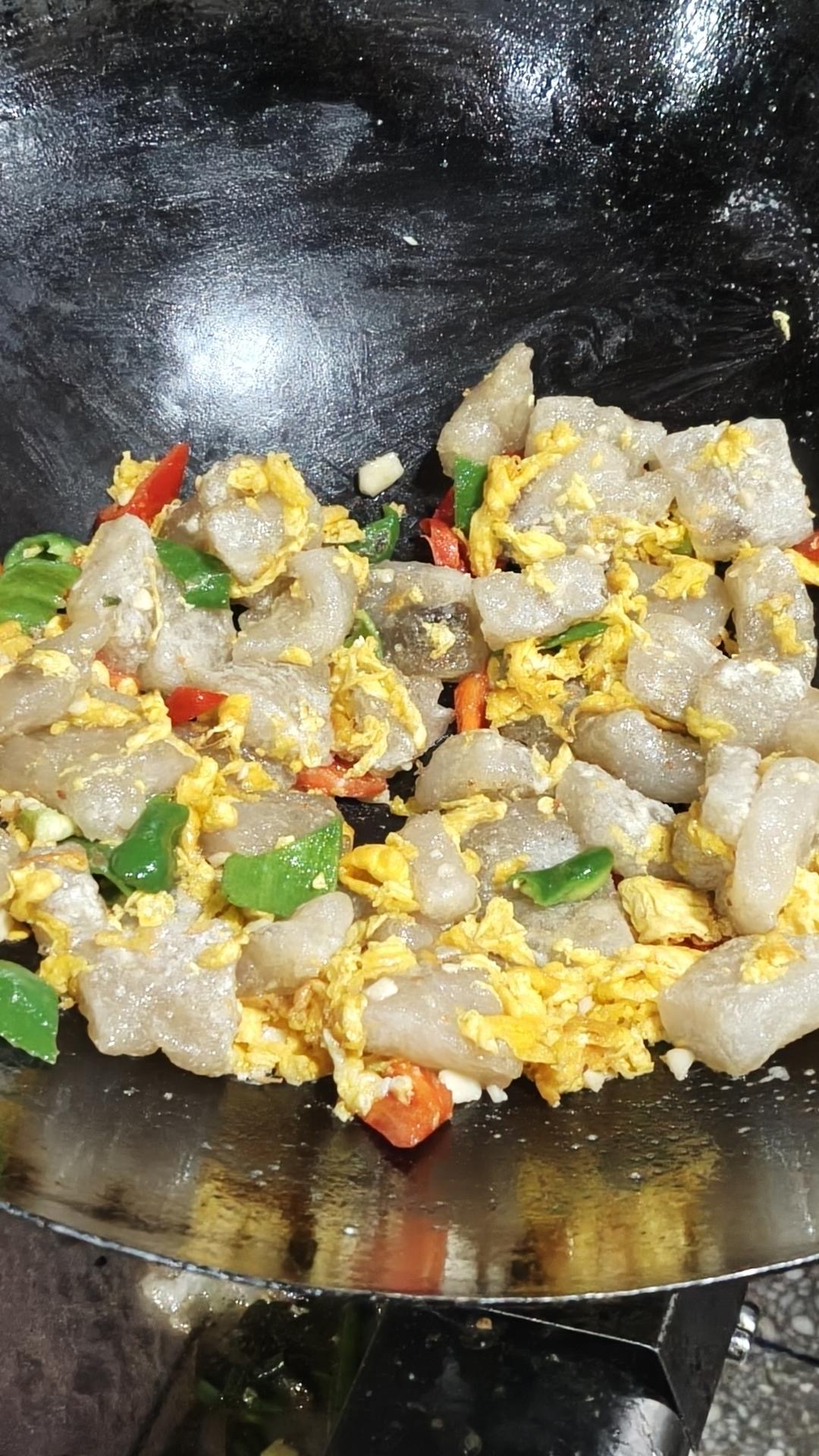
Step 7 — Stir-Fry Everything Together
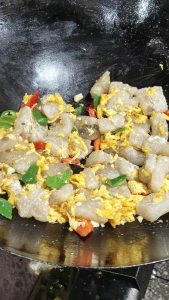
Tip the starch pieces into a slotted spoon and shake off the excess starch, push the scrambled egg to one side of the wok, add the minced garlic, then the green and red pepper pieces, and stir-fry briefly. Add the sweet potato starch pieces, season with salt, chicken bouillon powder, and MSG, and stir everything together until evenly coated.
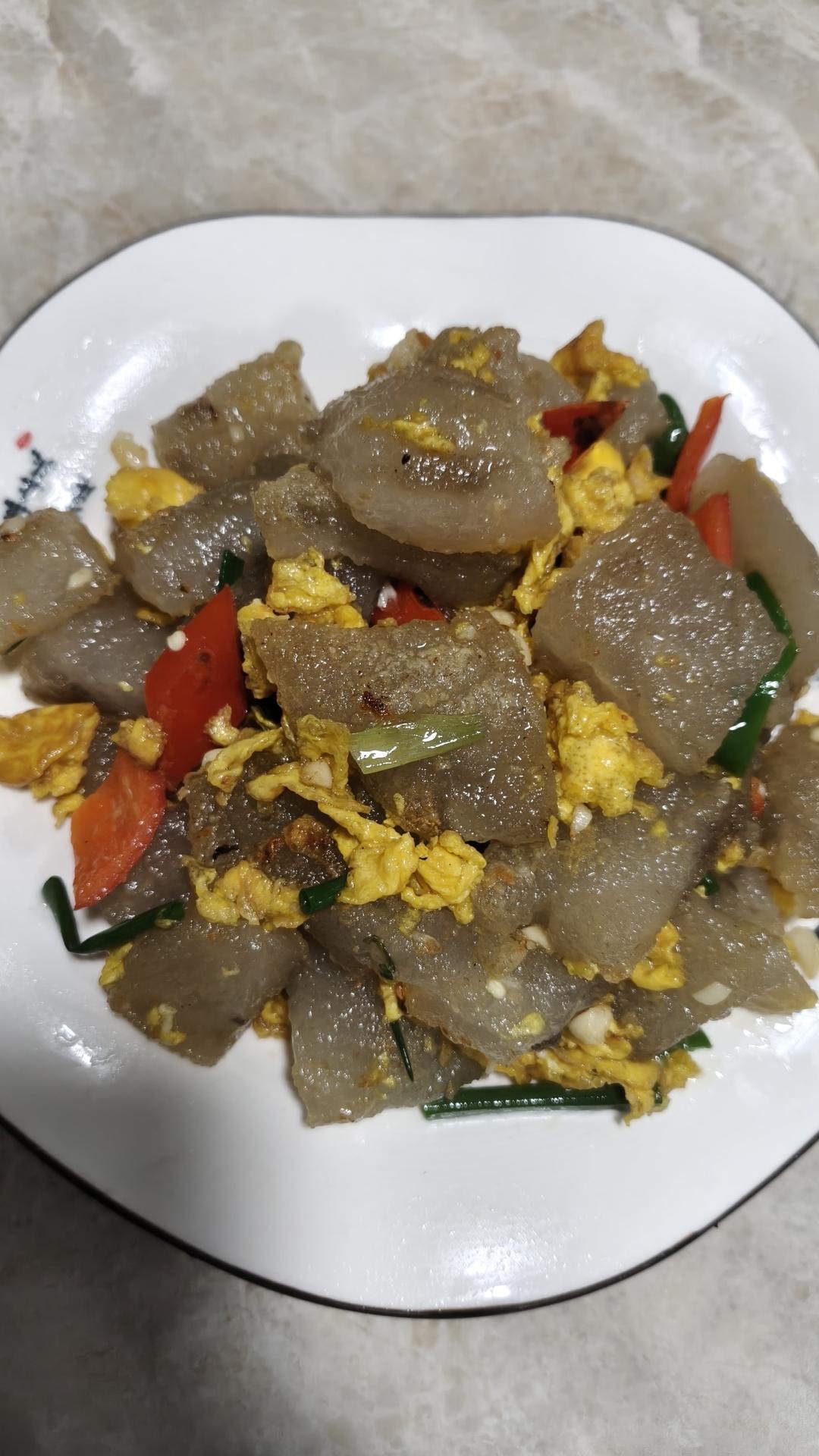
Step 8 — Finish with Scallions
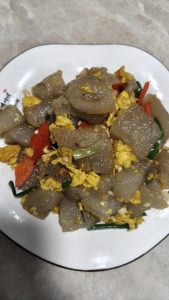
Finally add the scallion sections, stir once more to combine, and turn it out onto a plate to serve.
Common Mistakes When Making 红薯粉炒鸡蛋
1. Not soaking the starch long enough. This is the single biggest cause of a gummy result. The starch needs several hours for the granules to fully hydrate and settle. If you only soak it for twenty minutes, the cake will fry up unevenly and turn gluey in the wok. Fix: start it the night before and let it sit for at least eight hours.
2. Leaving too much water in the bowl. Even a few tablespoons of the clear top water will make the starch cake soft and sticky instead of firm. Fix: tilt the bowl and pour slowly, pressing gently on the starch with the back of a spoon to drain the last of the water. If it still looks loose, let it sit another thirty minutes and drain again.
3. Skipping the starch dusting on the cut pieces. Without that thin coating, the cubes stick to each other in the wok and clump into one mass. Fix: coat each piece individually, working one at a time, and shake off the excess in a slotted spoon before it goes into the pan.
4. Overcrowding the wok. If the starch cubes are piled too deep, they steam instead of fry and lose their chew. Fix: cook in two batches if your wok is small, or use a larger wok. The pieces should sit in a single layer when they first hit the oil.
5. Adding the seasoning too early. Salt draws moisture out of the starch and the eggs, and if it goes in before the starch is added, it will pool in the oil and leave the dish unevenly seasoned. Fix: wait until the starch cubes are in the wok, then sprinkle the salt, bouillon, and MSG over the top and toss immediately.
6. Cooking the eggs until they are dry. Eggs continue to cook from residual heat after you push them to the side. If you scramble them to a firm, dry curd before adding the starch, they will be rubbery by the time the dish is done. Fix: pull them off the heat while they are still slightly glossy and just barely set.
Variations
With pork. Thin slices of pork belly or ground pork added after the garlic turn this into a heartier main course. Brown the pork first, then push it aside and continue as written.
With dried shrimp. A small handful of soaked dried shrimp, added with the garlic, gives the dish a deep, briny savor that works beautifully with the chewy starch.
Spicier version. Add a spoonful of chili bean paste (doubanjiang) or a few dried chilies with the garlic. The starch absorbs the heat beautifully.
Vegetarian. Skip the chicken bouillon powder and use mushroom bouillon instead. The MSG is already vegetarian, so the dish stays fully plant-based apart from the eggs.
Different starch. Mung bean starch (绿豆淀粉) works in a pinch and gives an even bouncier texture, though the flavor is slightly cleaner. Do not substitute cornstarch — it will not hold together as a cake.
Frequently Asked Questions
Can I use sweet potato flour instead of sweet potato starch? No. They behave completely differently. Flour contains protein and fiber and will give you a dense, pasty cake rather than a chewy, translucent one. Check the bag carefully — the Chinese label should read 红薯淀粉 or 红薯粉.
How long does the starch really need to soak? At least eight hours, and overnight is better. The soak is not about flavor; it is about letting the starch granules fully hydrate and settle so you can drain off the excess water. Short soaks are the number one cause of a gummy result.
Can I make the starch cake ahead of time? Yes, and it is a great idea. Fry the cake, let it cool completely, and refrigerate it for up to two days. Cut and dust it just before stir-frying. In fact, chilled starch cake cuts more cleanly than warm cake.
Why did my starch cubes stick together in the wok? Either they were not dusted with starch, or the wok was overcrowded, or both. Coat each piece individually and shake off the excess in a slotted spoon, then cook in a single layer.
Is MSG necessary? No, but it does make a difference. If you prefer to leave it out, increase the chicken bouillon powder slightly and taste before serving.
How to Serve
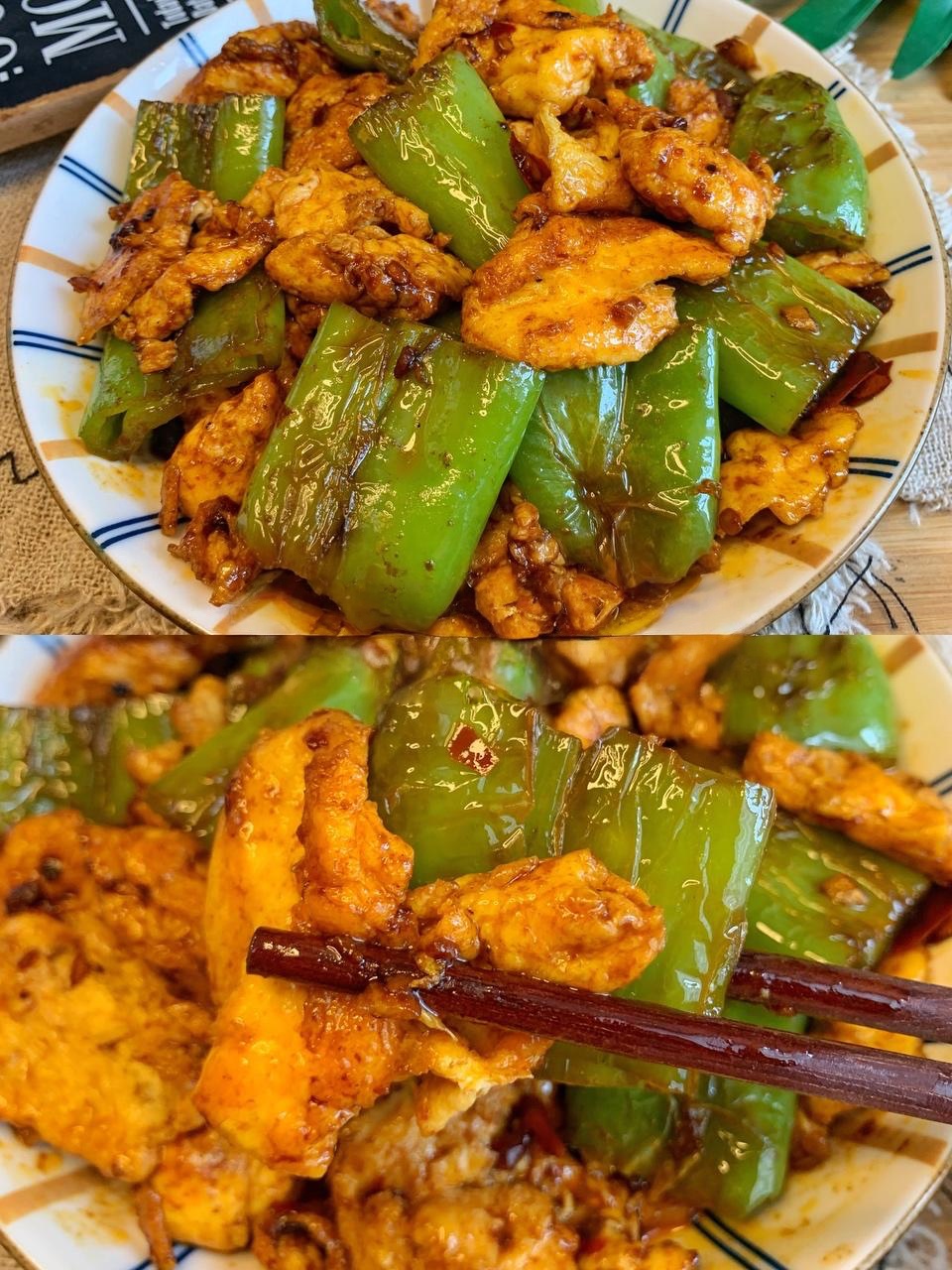
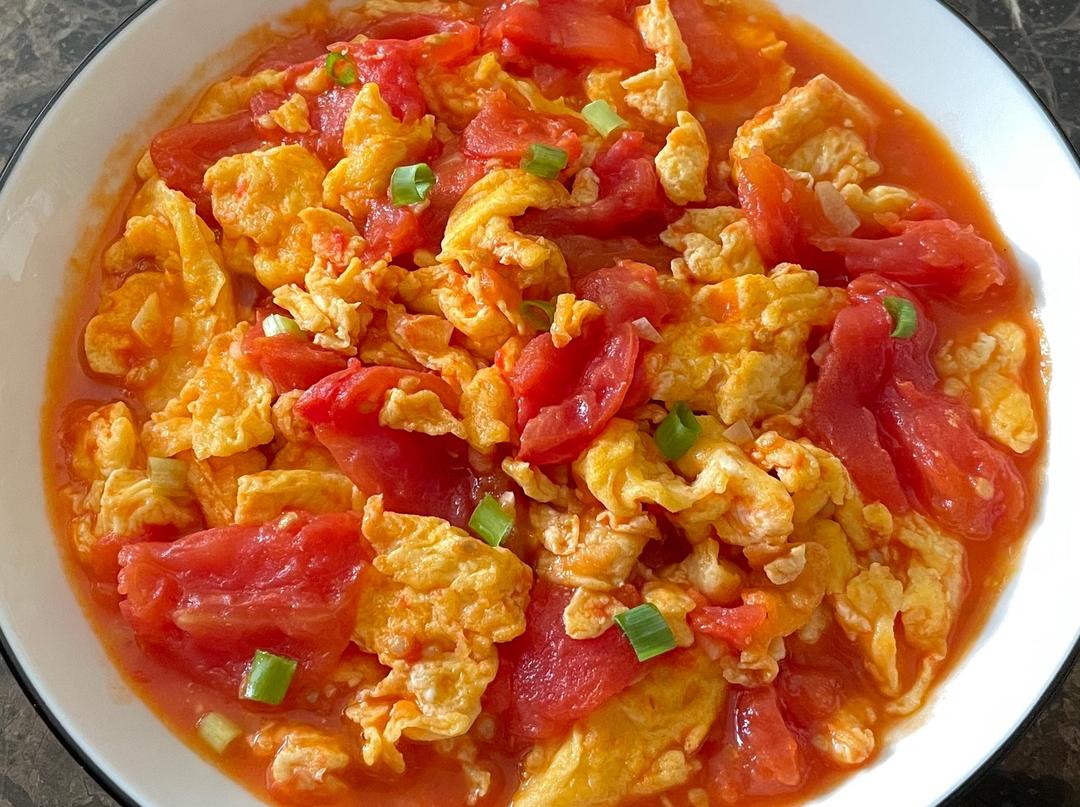
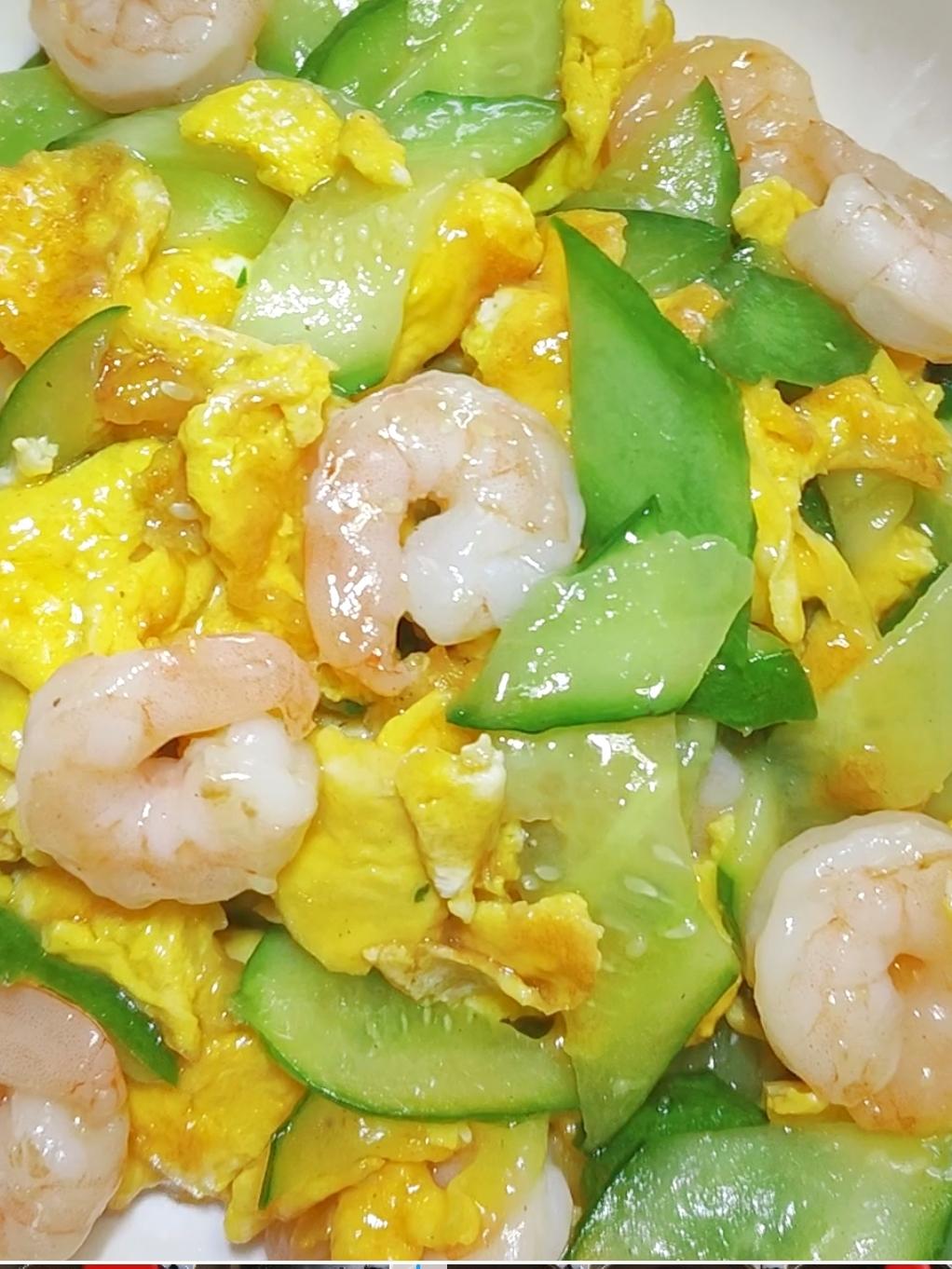
Stir-fried sweet potato starch with eggs is a main course in its own right, but it also works as part of a larger spread. Serve it with steamed white rice and a simple green vegetable, or alongside a bowl of light soup. If you want to build a full egg-forward table, our green pepper and egg stir fry is a natural companion, and the bright, tangy chinese tomato and egg stir fry balances the richness of the starch beautifully. For something a little more substantial alongside, try the shrimp cucumber and egg stir fry.
Storage & Reheat
Store leftovers in an airtight container in the refrigerator for up to three days. The starch will firm up as it chills, which is normal — it softens again when reheated. Reheat in a hot wok or skillet with a teaspoon of oil, tossing until heated through, or microwave covered for 1 to 2 minutes until steaming. Reheat to an internal temperature of 165°F (74°C).
You can also freeze the cooked starch cake on its own, before it is stir-fried, for up to two months. Thaw overnight in the refrigerator, then cut and dust as usual. The finished stir-fry with eggs does not freeze well because the eggs become watery, so plan to eat those leftovers within three days.
Allergen Notice
This dish contains eggs. If you are cooking for someone with an egg allergy, the starch cake itself is egg-free and can be served on its own with the peppers and garlic. Check the labels on your chicken bouillon powder and MSG for hidden allergens, and confirm that your sweet potato starch was processed in a facility that does not also handle wheat.
Nutrition Disclaimer
Nutrition information is calculated using an ingredient database and should be considered an estimate. In cases where multiple ingredient alternatives are given, the first listed is calculated for nutrition. Garnishes and optional ingredients are not included.
About the Author & Recipe Development
Lin is the cook and writer behind Woks of Love, where she shares the Chinese home cooking she grew up with and the restaurant techniques she has picked up along the way. This version of 红薯粉炒鸡蛋 was developed from a commercial-kitchen formula that relies on a long soak and a firm pan-fried starch cake, then adapted for a single wok and a home stove. It has been tested repeatedly to make sure the starch stays chewy rather than gummy and the eggs stay soft rather than rubbery.
For another dish in the same spirit, cucumber and egg stir fry with ham is worth cooking next.
For another dish in the same spirit, carrot and onion egg stir fry is worth cooking next.
Authoritative References
For safe egg handling and internal temperatures, see the FDA guidance on food safety and eggs. For general safe minimum cooking temperatures, the USDA safe temperature chart is the standard reference. For an explanation of how starch gelatinizes and retrogrades when cooked and cooled, see this food science explainer on starch gelatinization.
Stir-Fried Sweet Potato Starch with Eggs (红薯粉炒鸡蛋): Chewy Starch

Equipment
- Wok
- Cutting Board
- Slotted Spoon
Ingredients
For the Starch Cake
- 300 g sweet potato starch about 0.6 lb, coarse or fine
- 4 cups water for soaking and settling
- 2 tbsp neutral oil for pan-frying the starch cake
For the Egg and Stir-Fry
- 3 large eggs beaten, no seasoning needed
- 3 tbsp neutral oil for the wok, divided
- 3 cloves garlic minced
- 1 small green bell pepper cut into 1-inch pieces
- 1 small red bell pepper cut into 1-inch pieces
- 1 tsp salt or to taste
- 1/2 tsp chicken bouillon powder optional
- 1/2 tsp MSG optional
- 2 stalks scallions cut into 2-inch sections
Instructions
- Put 0.6 jin (300 g) of sweet potato starch into a bowl, add no seasoning at all, and pour in more water than you think you need. Stir until no lumps remain, then let it settle for a good while. Once the starch has settled, pour off all the excess water on top and keep only the firm starch below, then heat salad oil in a wok and fry it into one flat cake.

- Cut the fried starch cake into bite-sized blocks.

- Sprinkle a little starch over the surface of the pieces.
- Add a bit more starch and coat each piece on all four sides, which keeps them from sticking together.
- Coat every single piece in starch, working one piece at a time, then put them back into the bowl and set aside.
- Crack three eggs into a bowl with no seasoning needed and beat them until smooth. Heat salad oil in the wok, pour the eggs straight in, and stir-fry them until broken into soft curds.
- Tip the starch pieces into a slotted spoon and shake off the excess starch, push the scrambled egg to one side of the wok, add the minced garlic, then the green and red pepper pieces, and stir-fry briefly. Add the sweet potato starch pieces, season with salt, chicken bouillon powder, and MSG, and stir everything together until evenly coated.
- Finally add the scallion sections, stir once more to combine, and turn it out onto a plate to serve.












Leave a Reply