Hey there! Welcome back to my kitchen.
Let’s be real for a second: when you see a slab of pork skin in a Western grocery store, your first instinct might be to trim it off and toss it in the bin. I get it. In many Western culinary traditions, it’s seen as chewy, rubbery, or just “scrap.”

But growing up in my parents’ loud, chaotic restaurant in Chengdu, throwing away pork skin would have been a crime. To a Chinese chef, pork skin isn’t waste—it’s liquid gold.
I remember watching my dad hunched over the prep table, meticulously scraping skins with a cleaver. He told me, “Lin, the meat gives the flavor, but the skin gives the soul.” He was talking about texture. That sticky, lip-smacking richness that coats your tongue? That comes from the skin.
Today, I’m taking off my chef’s hat and putting on my science goggles to show you exactly why we use it, how to prep it, and how to turn this humble ingredient into something spectacular.
The “Why”: It’s All About the Collagen
Culinary school taught me the chemistry behind what my parents did by instinct. Pork skin is almost entirely connective tissue, specifically collagen.
When you cook collagen slowly with heat and water, it breaks down into gelatin. This is the secret weapon.
- In Braises: It thickens the sauce naturally, giving it a glossy sheen that cornstarch just can’t replicate.
- In Fillings: It captures liquid, allowing us to put soup inside a dumpling (more on that later).
- Mouthfeel: This is a huge concept in Chinese cuisine. We don’t just eat for flavor; we eat for texture. We want that “Q-texture”—bouncy, springy, and slightly sticky, like a flexed muscle.
The Prep: The “No Secrets” Cleaning Method
Before you can use pork skin, you have to treat it right. If you skip this, your dish will taste “funky” or greasy.
1. The Hair Must Go Nothing ruins a meal faster than a stray bristle.
- Western Kitchen Hack: If you don’t have a culinary blowtorch to singe the hairs off (the traditional way), use a cheap, disposable razor. Trust me on this—it works perfectly on the raw skin.
2. The Blanch and Scrape Put the skin in cold water with a splash of Shaoxing Wine and bring it to a boil for 3-5 minutes.
- Sensory Cue: The skin will turn from translucent pink to a firm, opaque white, and the scum will float to the top. Remove it, let it cool slightly, and here is the most critical step: Scrape the inside. You need to use a knife to scrape away every bit of soft white fat attached to the underside of the skin. You want only the translucent skin, no lard.

3 Ways We Use Pork Skin
1. The Braise Enhancer (Red Braised Pork)
If you’ve ever tried my Braised Pork Belly, you know that we leave the skin on. When braised for hours, the skin becomes incredibly soft—”melt in your mouth” soft—but it holds the cube together. Without the skin, the fat would render out completely, and the meat would fall apart. The skin acts as a barrier, basting the meat in its own juices while thickening your soy sauce and sugar glaze into a sticky masterpiece.
2. The Soup Dumpling Secret (Xiao Long Bao)
Have you ever wondered how the soup gets inside the dumpling? It’s not magic; it’s pork skin. Chefs simmer pork skin for hours until the water turns into a concentrated broth. When you chill this broth, the gelatin turns it into a solid jelly. We chop that jelly up and mix it into the Pork Dumpling Filling. When you steam the dumpling, the jelly melts back into soup inside the wrapper. Genius, right?
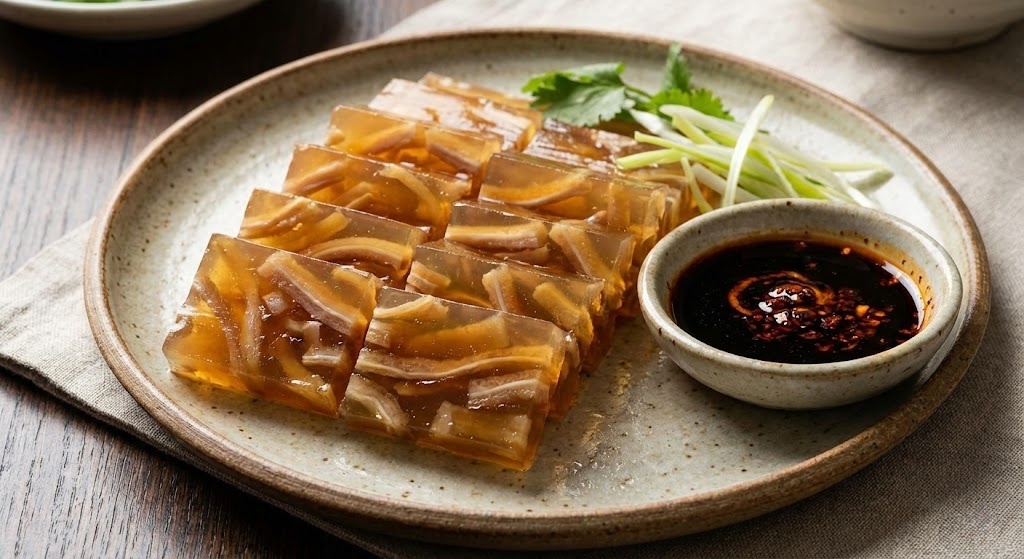
3. Crystal Pork Skin Jelly (Pi Dong)
This is a classic cold appetizer in Northern China and a favorite in my family. It’s essentially pork skin boiled until it dissolves, then set into a clear, firm block. It sounds strange to Western ears, but sliced thin and dipped in Chili Garlic Sauce, it is refreshing, cooling, and full of protein.
Recipe: Crystal Pork Skin Jelly (Pi Dong)
This is the ultimate test of your pork skin skills. It’s simple, cheap, and undeniably authentic.
Prep Time: 20 mins (+ cooling time) Cook Time: 90 mins
Ingredients
- 500g Pork Skin (Ask your butcher; they often give it away or sell it cheap).
- 4 cups Water.
- 2 slices Ginger.
- 1 Scallion (green onion).
- 1 tbsp Shaoxing Wine.
- A pinch of salt.
Instructions
- Clean: Remove all hair and wash the skin.
- Blanch: Boil for 5 minutes. Drain.
- Scrape: This is the step you cannot rush. Scrape off all the fat until the skin is translucent. If you leave fat, your jelly will be cloudy and greasy.
- Slice: Cut the skin into thin strips, about the width of a fettuccine noodle.
- Simmer: Place the strips in a pot with fresh water, ginger, scallion, and wine. Bring to a boil, then turn the heat down to the lowest setting.
- Sensory Cue: You want a gentle bubble. If it boils too hard, the broth becomes milky (which is fine for ramen, but we want crystal jelly here).
- Cook: Simmer for 60-90 minutes until the liquid is slightly thick and sticky.
- The Test: Dip a spoon in and let it cool for a minute. If the drop gets tacky and sticky on your finger, it’s ready.
- Set: Remove the ginger and scallions. Pour the liquid (and the skin strips!) into a rectangular container. Let it cool on the counter, then refrigerate overnight.
How to Serve
Slice the jelly into cubes or thin rectangles. The texture should feel bouncy, resisting your teeth just a little bit before giving way. Serve it cold with a mixture of Chinese Black Vinegar, Soy Sauce, minced garlic, and a splash of chili oil.
If you enjoy the rich, gelatinous texture of pork skin, you should definitely try my Braised Pork Trotters. It uses the exact same principles to create a sauce that is incredibly rich and savory.
Lin’s “No Secrets” Troubleshooting
- “My jelly didn’t set!” You likely added too much water or didn’t boil it long enough. The ratio of collagen to water needs to be high. Next time, boil it for another 20 minutes to reduce the liquid.
- “It tastes bland.” Pork skin itself is flavorless! It is a vessel for texture. This is why the dipping sauce is mandatory, not optional. It’s like tofu—it needs a partner.
- “Can I use this for soup dumplings?” Yes! But for soup dumplings (Xio Long Bao), we usually blend the skin into the liquid completely or strain the skins out so you just have a pure block of gelatin broth.
Western Kitchen Substitutions
If you can’t find loose pork skin, buy a pork belly or a pork shoulder with the skin on. You can trim the skin off to make this jelly, and use the meat for something else, like my Twice-Cooked Pork. It’s a win-win: zero waste and two meals.
Next time you are at the butcher, don’t be shy. Ask for the skin. You’ll be adding a pro-level tool to your culinary arsenal.
Would you like me to guide you through a specific recipe using that pork meat you just saved, like a quick stir-fry?
Authoritative References
- On the Science of Collagen and Gelatin: For a deeper dive into how collagen breaks down into gelatin and affects food texture, ScienceDirect provides an excellent overview of the chemical process. Read the study here.
- Nutritional Profile: For those curious about the nutritional components of pork skin (including protein and fat content), Healthline breaks down the data clearly. View nutritional data.












Leave a Reply