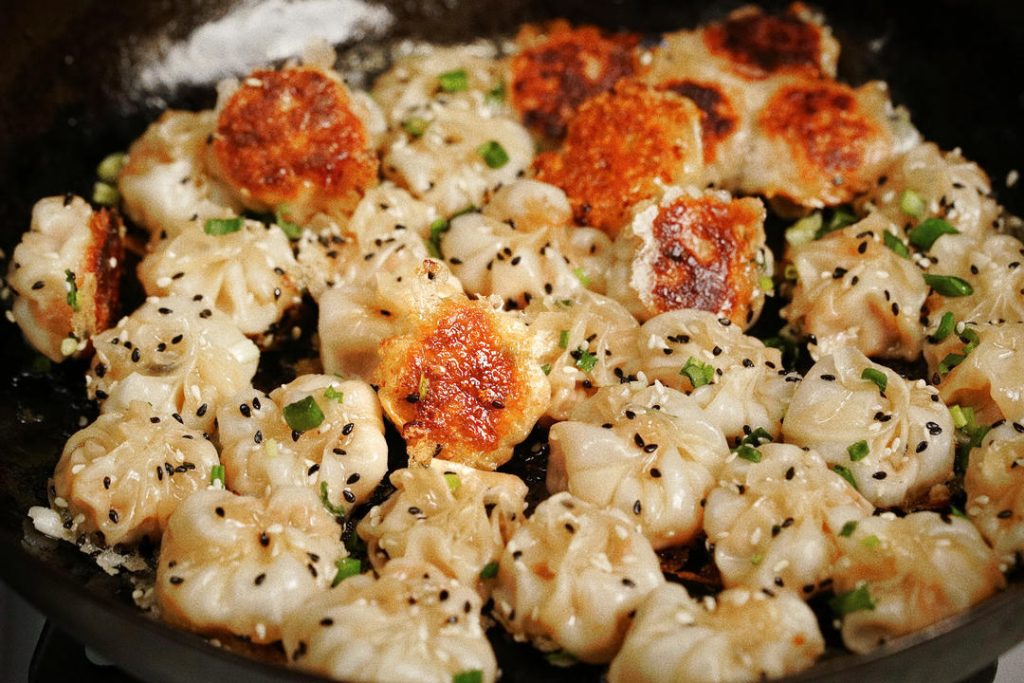
On a stormy typhoon night, with the wind howling against the windowpanes, there is an ancient, hardwired culinary instinct that calls for comforting, crispy carbs. For me, that meant pulling a fresh batch of Thumb Pan-Fried Buns (拇指生煎, Mǔ Zhī Shēng Jiān) out of the freezer. I arranged them tightly in a skillet, swirled in a hit of cooking oil and structured starch slurry, and waited for that holy five-minute transformation.
These may be miniature, one-bite versions of Shanghai’s famous street food classic, but the foundational elements remain perfectly intact: a golden, deeply shattered bottom crust and a piping-hot, explosive savory meat filling. No carb lover can escape their gravitational pull. Because traditional yeast dough can be finicky and time-consuming for a weeknight dinner, I have spent years perfecting two professional kitchen hacks to streamline the workflow without sacrificing authentic flavor: using store-bought wonton wrappers to bypass the kneading process, and using a high-quality broth concentrate to construct a stable soup jelly.
Whether you dress them in chili sauce, serve them threaded on skewers, or enjoy them straight out of the hot skillet for breakfast or a midnight snack, these miniature flavor bombs deliver total satisfaction. Let’s look at the parameters to recreate this homestyle luxury in your own kitchen.
What Is Thumb Sheng Jian Bao?
Traditional Sheng Jian Bao (生煎包) is a classic Shanghai street food featuring a fluffy, partially leavened yeast wrapper stuffed with pork and pork skin gelatin. It is fried raw in massive iron pans until the bottoms are deeply caramelized and crispy while the inside yields a pool of hot savory soup.
Thumb Sheng Jian Bao (拇指生煎) is a modern, high-efficiency evolution of this street classic, scaled down to a bite-sized format. Because we use thin, unleavened wonton wrappers instead of a yeast dough, the texture profile shifts significantly. Rather than a thick, bready bun, you get a paper-thin, delicate top wrapper that resembles a pan-fried dumpling, paired with an intensely concentrated crunch on the bottom.
Master Starch Slurry Formula (The Secret to the Crispy Lattice)
2 tsp cornstarch
1 tsp all-purpose flour
1 tsp neutral cooking oil
1 standard cup (240 ml) room-temperature water
Ingredient Choices: Pork Collar vs. Pork Loin
To guarantee a juicy interior, the fat-to-lean ratio of your pork mince must sit exactly between 70:30 and 80:20.
💡 Chef’s Slicing Secret: To achieve a perfect textured mince by hand without a food processor, slice the pork collar across the grain using crosshatch cuts spaced 2 mm apart. Do not cut completely through the flesh. Flip the meat over, repeat the crosshatch pattern, slice into strips, and chop finely for 2 minutes. This creates a cohesive bite-sized grind that traps the liquid gelatin effectively.
Equipment Needed
12-inch Heavy-Bottomed Non-Stick Skillet or Cast Iron Pan: A heavy pan is critical because it acts as a thermal battery, preventing severe heat drops when liquid is introduced.
Flat Wok Spatula: Essential for checking the bottom color and turning the buns smoothly.
Digital Liquid Thermometer: To verify precise oil and starch slurry evaporation temperatures.
Prep & Mise en Place
1. Constructing the Broth Jelly
To a small saucepan over high heat, add 1.7 cups (400 ml) of water, 2 blocks of broth concentrate, ginger slices, scallion sections, and whole Sichuan peppercorns. Bring to a rolling boil, then lower the heat to medium and simmer for 5 minutes to infuse the aromatics. Strain the liquid through a fine-mesh sieve into a shallow container, discarding the solids. Let it cool completely to room temperature, then transfer to the refrigerator for at least 4 hours until it sets into a firm, sliceable gelatin matrix.
2. Developing the Filling Matrix
Weigh out 12.3 oz (350g) of your set broth jelly and chop it finely into 2 mm cubes. In a large glass mixing bowl, combine the minced pork collar and chopped water chestnuts. Add the light soy sauce, dark soy sauce, oyster sauce, sesame oil, sea salt, sugar, white pepper, five-spice powder, chopped scallions, the whole egg, and the diced broth jelly.
Stir the mixture vigorously in a strict clockwise direction using chopsticks or a wooden spoon for 10 to 15 minutes.
Why stir in one direction? Continuous directional stirring untangles the myosin proteins in the lean meat, forcing them to link into a strong cross-linked matrix. This process, known as shàng jìn (上劲), turns the loose pork into a bouncy meatball that traps the melting soup jelly during cooking.
The filling is fully developed when a single chopstick inserted into the center stands perfectly vertical without leaning. Cover with plastic wrap and chill in the refrigerator for 30 minutes to firm up the fat.
Cooking Process: Step-by-Step
1. Assembling the Buns
Take a wonton wrapper and use a rolling pin to gently stretch the edges on a lightly floured surface, making them slightly thinner than the center. Brush a thin perimeter of room-temperature water along the outer edges to create a secure seal. Place exactly 10 grams of chilled pork filling in the middle. Gather the pleated edges around the filling, rotating the wrapper sequentially while pinching the dough tightly at the peak to form a small, cinched purse shape. Keep the completed raw buns underneath a damp paper towel to prevent the skins from drying out.
2. Establishing the Bottom Sear
Place your heavy skillet over low heat. Arrange the thumb buns inside the pan, leaving a 5 mm gap between each bun to prevent overcrowding. Swirl 2 tablespoons of high-smoke-point neutral oil around the perimeter of the skillet.
Let the buns fry completely undisturbed for 3 minutes until the bottom starch sets into a light, uniform golden-brown shell.
3. The Steam-Drying Phase
Whisk your Master Starch Slurry Formula thoroughly to ensure the flour and cornstarch are completely suspended. Pour the mixture directly into the skillet, ensuring the liquid reaches halfway up the sides of the mini buns.
Immediately cover the skillet with a tight-fitting lid and turn the heat up to medium. Simmer for 5 minutes.
During this phase, the trapped water vapor creates intense convection heat that cooks the pork meatball thoroughly while steaming the top wrappers until they are tender and translucent.
4. Releasing the Crispy Lattice Crust
Uncover the skillet. The water should be entirely evaporated, leaving a thin layer of starch paste bubbling in the oil at the bottom of the pan. Keep heating over medium-low heat for an additional 60 to 90 seconds, gently shifting the pan around the heating element to ensure even browning.
Once the starch paste transforms into a beautiful, deeply amber, lace-like crispy sheet connecting the buns, turn off the heat. Sprinkle the white and black sesame seeds and finely chopped scallions evenly across the top. Serve immediately.
Why This Recipe Works
Cross-Linked Starch Slurry: Combining cornstarch with all-purpose flour yields a superior bottom crunch. The flour supplies gluten for structure, while the cornstarch contributes pure amylose, which dries out into a light, glass-like shattered texture.
Directional Myosin Binding: Beating the meat in a single direction forms an emulsified paste that retains both the melting fat and the liquefied broth jelly, eliminating dry, crumbly centers.
The No-Knead Wonton Shortcut: Bypassing traditional yeast dough drops the total prep time by 90 minutes while providing a delicate, ultra-thin top wrapper that lets the filling stand out.
Common Mistakes & Troubleshooting
The Buns Leak Fluid into the Pan: If the top pleats are not twisted tightly, or if you use an erratic cutting motion that pierces the wrapper, the internal soup jelly will escape into the skillet. This causes massive hot oil splatters and burns the bottoms instantly. Ensure a tight, water-brushed seal before frying.
The Top Skin is Tough and Raw: This happens if the pan lacks adequate water vapor or if the skillet lid does not seal well. If the top wrapper feels rigid at the 4-minute mark, lift the lid quickly and mist 1 tablespoon of hot water directly onto the upper skins, then reseal immediately.
Food Safety and Preparation Guidelines
Because this recipe contains raw pork and eggs, proper thermal safety rules must be followed to avoid foodborne illness:
Ensure the internal core temperature of the center pork meatball reaches a minimum threshold of 160°F (71°C)before turning off the heat. You can verify this parameter using a digital food thermometer inserted through the top pleat of a sacrifice bun.
Never leave raw, assembled buns sitting at room temperature for more than 20 minutes, as wonton wrappers will rapidly absorb moisture from the filling and break apart.
Freezer Storage Tip: Raw thumb buns can be safely frozen on a parchment-lined baking sheet overnight. Once frozen solid, transfer them to airtight storage bags where they maintain peak quality for up to 1 week. Cook directly from frozen by extending the covered steaming phase to 7 minutes.
How to Serve
Thumb sheng jian bao is best enjoyed boiling hot straight from the skillet. Pair it with a classic dipping bowl of 3 parts Chinkiang black vinegar and 1 part Chinese Chili Oil or Homemade Chili Garlic Sauce to cut through the rich fat of the pork.
To create a balanced dim sum breakfast feast or a late-night street food experience, round out your table with these traditional sides:
Refreshing Palate Cleaners: Balance the pan-fried heat with a crisp Smashed Cucumber Salad.
Real Reader Reviews
⭐⭐⭐⭐⭐ Marcus K. (Munich, Germany): “The wonton wrapper hack completely changed my dim sum game. I made these for Sunday brunch and my guests could not believe they weren’t from a high-end restaurant. The bottom crunch is otherworldly!”
⭐⭐⭐⭐⭐ Elena R. (Seattle, USA): “I was terrified of making soup dumplings or sheng jian because of the dough-rolling process. Lin’s shortcut using wonton wraps is sheer genius. Trapped the soup perfectly and took me under 40 minutes total.”
About the Author & Recipe Development
I am Lin, a professional chef and culinary developer with over a decade of hands-on experience in high-volume restaurant kitchens. Having grown up in Sichuan Province surrounded by a family of professional chefs, precision, heat metrics, and structural flavor balance are deeply ingrained in my work.
This specific recipe for thumb sheng jian bao was developed in my home kitchen to solve a common problem: recreating the hyper-localized flavor of Shanghai street food using Western supermarket shortcuts. This formulation underwent four rounds of variable testing—comparing wrappers, tracking fat-to-lean breakdown ratios, and adjusting starch weights—to ensure that home cooks can achieve a flawless, shatteringly crisp result on standard home electric or gas cooktops.
Can I use store-bought gyoza wrappers instead of wonton wrappers?
No. Gyoza wrappers are significantly thicker and contain more starch, which prevents them from softening nicely during the brief 5-minute steaming phase. They will turn out tough and chewy at the top pleats. Shanghai-style square wonton wrappers are essential for a delicate, silk-like top skin.
My starch lattice turned into a sticky paste instead of a crispy sheet. What went wrong?
This occurs when the pan temperature is too low or if you skip adding the teaspoon of oil to the slurry mixture. Without sufficient oil and high heat to fry the remaining starch after the water vanishes, the starch cannot dehydrate into a crisp structure. Keep heating the pan over medium until the moisture fully evaporates and the starch turns golden brown.
Can I make this dish completely vegetarian?
Yes. You can swap the minced pork for a mixture of finely chopped firm tofu, shiitake mushrooms, and glass noodles. Use a vegetable-based broth concentrate cube combined with 1 tablespoon of agar-agar powder to build your vegetarian soup jelly matrix.
Allergen Notice & Comprehensive Nutrition Profile
Allergen Notice
This recipe contains Gluten (wonton wrappers, all-purpose flour), Soy (light and dark soy sauce), Oyster/Shellfish(oyster sauce), and Eggs (filling binder). It is completely free from tree nuts, peanuts, and dairy.
Nutrition Disclaimer
Nutrition information is calculated using an ingredient database and should be considered an approximate estimate. Variations will occur depending on brand selections and precise fat ratios of your pork cuts.
Estimated Nutrition Facts
Serving Size: 1 portion (approx. 8 thumb buns)
Calories: 410 kcal
Total Carbohydrates: 32g (11% Daily Value)
Dietary Fiber: 2g (7% Daily Value)
Sugar: 3.5g
Protein: 22g (44% Daily Value)
Total Fat: 24g (31% Daily Value)
Saturated Fat: 8g (40% Daily Value)
Cholesterol: 115mg (38% Daily Value)
Sodium: 1,280mg (56% Daily Value)
Potassium: 340mg
Calcium: 45mg
Iron: 3.2mg
Crispy One-Bite Thumb Pan-Fried Buns (拇指生煎)
Lin
A modern, high-efficiency Shanghai street food shortcut utilizing wonton wrappers to bypass dough kneading, delivering a deeply crispy bottom crust and a burst of savory hot soup in every bite.
12.3ozprepared broth jelly350g, diced to 2mm cubes
Assembly & Starch Slurry Lattice
1packShanghai square wonton wrappersThin, pliable sheets used as dough substitute
2tspcornstarchFor lattice crispy lightness
1tspall-purpose flourProvides structural webbing to lattice
3tbspneutral cooking oilDivided for pan coat and slurry formula
2tbspmixed sesame seedsGarnish
Instructions
Simmer drinking water, broth cubes, ginger, scallion sections, and Sichuan peppercorns for 5 minutes. Strain and chill the clear liquid for 4 hours until it sets into a firm gel.
Combine pork mince, water chestnuts, liquid spices, seasonings, egg, and 350g of finely diced broth jelly in a bowl. Stir continuously clockwise for 12 minutes until a sticky, firm paste forms; chill for 30 minutes.
Roll the outer edges of a wonton wrapper thin, wet the perimeter, place 10g filling in the center, and gather the edges upward into tightly pinched pleats to seal completely.
Arrange the buns inside a cool skillet with a 5mm gap between each, add 2 tablespoons of oil around the sides, and fry over low heat for 3 minutes until the bottoms lock into a golden shell.
Whisk the water, cornstarch, flour, and 1 teaspoon of oil together. Pour directly into the skillet, cover tightly with a lid immediately, and steam over medium heat for 5 minutes.
Uncover the skillet and let the residual starch paste fry in the remaining oil for 90 seconds until a brown lace lattice forms. Garnish with sesame seeds and chopped scallions, then serve hot.
Notes
Ensure the internal core temperature of the center buns reaches 160°F (71°C) using a digital probe thermometer for complete food safety. Allergen Alert: Contains Gluten, Soy, Shellfish, and Eggs. Nutrition information is calculated using an ingredient database and must be considered an estimate.
Keyword Pan-Fried Buns, Shanghai Street Food, Thumb Sheng Jian Bao
I’m Lin, a professional chef with over a decade of experience, and I grew up in my family’s Sichuan restaurant. On my blog, Woks of Love, I share the authentic Chinese recipes I’ve spent my life learning, and I’m currently writing my debut cookbook.
I’m Lin, a professional chef with over a decade of experience, and I grew up in my family’s Sichuan restaurant. On my blog, Woks of Love, I share the authentic Chinese recipes I’ve spent my life learning, and I’m currently writing my debut cookbook.












Leave a Reply