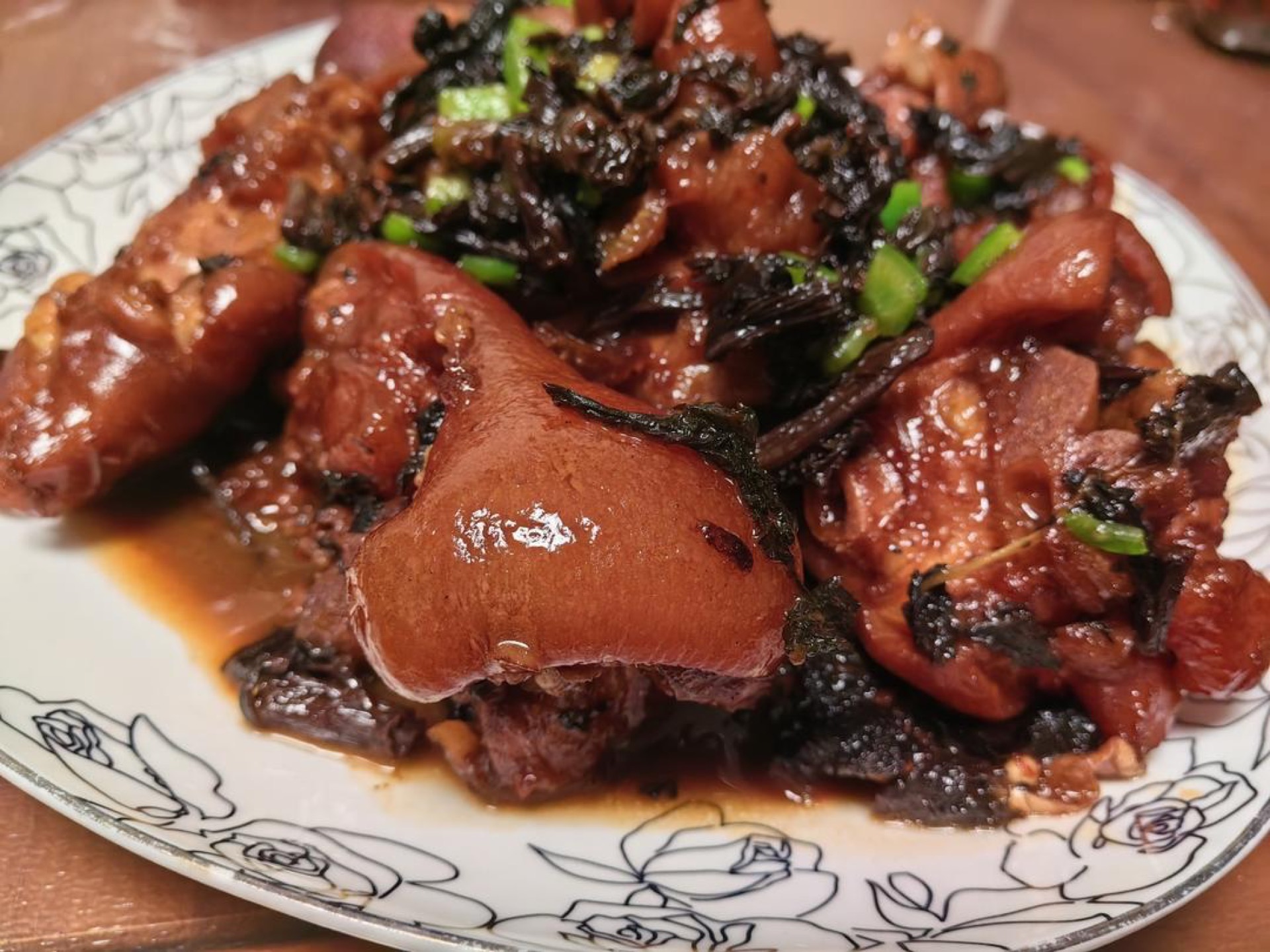
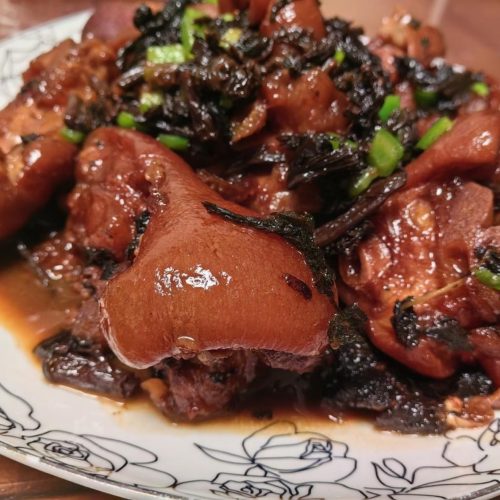
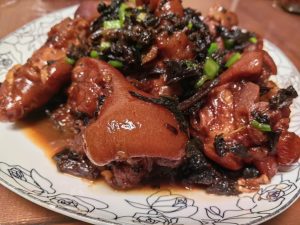
There’s a particular smell that fills a Chinese kitchen when pork trotters and preserved mustard greens meet in a wok — sweet caramel, funky fermented greens, star anise, and the slow promise of collagen turning to silk. Braised pork trotters with preserved mustard greens (梅干菜猪蹄) is the kind of dish that looks humble in the pot and tastes like a restaurant secret. The trotters cook down until the skin is jiggly and the meat slides off the bone, while the mei gan cai drinks up the soy-and-caramel braising liquid until every strand is dark, glossy, and intensely savory.
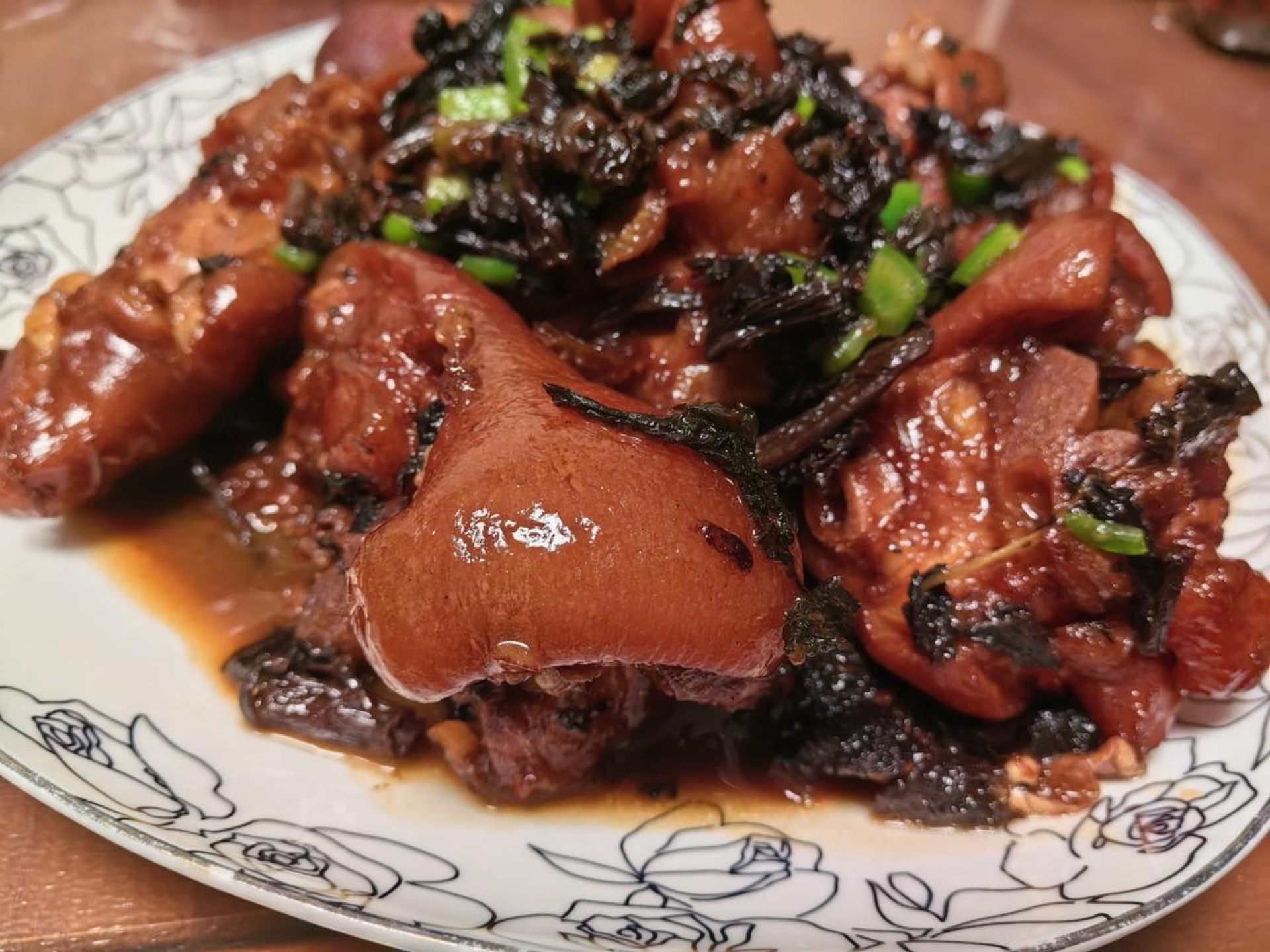
This is a Jiangnan homestyle classic, the sort of thing a grandmother makes on a Sunday when the family is coming over. It’s not a quick dish — trotters need time — but it’s almost entirely hands-off once the braise starts. You blanch, you caramelize, you add aromatics, and then you let the wok do the work while the apartment fills with the smell of star anise and fermented greens. If you’ve only ever had pork trotters in a restaurant, this recipe will convince you they belong in your regular rotation.
I’ve been making this version for years, tweaking the aromatics each time — extra ginger, a heavy hand with bay leaves, a spoonful of white angelica powder because I love the fragrance. It’s forgiving. The proportions below are what I’ve landed on as the most balanced: enough sugar to glaze the trotters, enough soy to season the greens, and enough aromatics to make the whole pot smell like a proper Chinese kitchen.
What Is Braised Pork Trotters with Preserved Mustard Greens?
Braised pork trotters with preserved mustard greens is a Chinese braised dish made from pork trotters (the feet and lower leg of the pig, skin-on and bone-in) and mei gan cai (梅干菜), a dried, fermented mustard green that’s salty, funky, and deeply savory. The trotters are blanched, caramelized in rock sugar, then simmered low and slow with soy sauce, aromatics, and the rehydrated greens until everything is tender and the sauce is thick and glossy. The greens are the star as much as the pork — they soak up the braising liquid and turn almost meaty in texture.
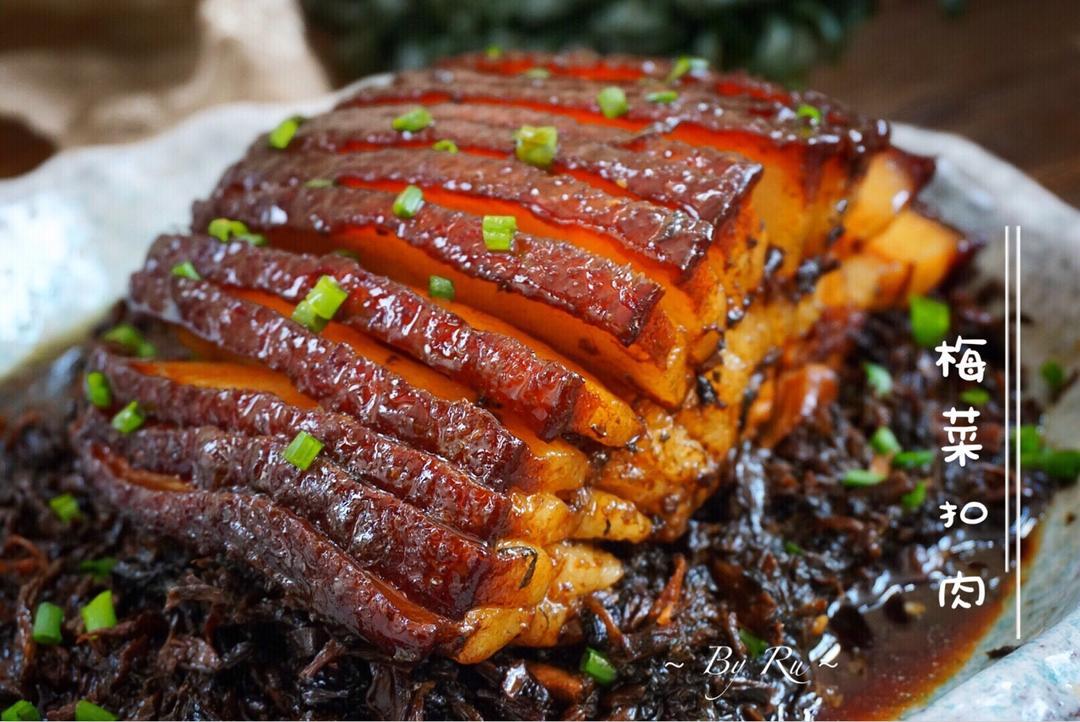
In Jiangnan cooking, mei gan cai is a pantry staple, used in dishes like mei cai kou rou (steamed pork belly with preserved greens) and mei gan cai shao rou (braised pork with preserved greens). Pairing it with trotters instead of belly is a homestyle variation — the trotters bring more collagen and a stickier, more gelatinous sauce, which the greens absolutely love. The result is rich, salty-sweet, and intensely aromatic, with a texture that’s soft but not mushy.
The dish is traditionally served with plain steamed rice, which is the perfect neutral canvas for the salty, sticky sauce. A simple stir-fried green vegetable on the side balances the richness. If you’ve never cooked with trotters before, this is a good place to start — the long braise is forgiving, and the greens hide any imperfections.
If you love the deep, savory flavor of Chinese braised pork but want something a little different from the usual belly, apple braised pork steaks are a great weeknight-friendly alternative — sweet, tangy, and ready in about 30 minutes. apple braised pork steaks
1Easy Apple-Braised Pork Steaks (苹果炖猪排)Incredibly juicy, tender pork steaks braised in a savory-sweet and fruity apple-onion sauce. A one-pan, 30-minute meal perfect for any weeknight!Check out this recipe

For a more classic take on Chinese braised pork, homestyle braised pork belly (bazi rou) is the dish that taught me how caramelized sugar and soy sauce can transform a humble cut. braised pork belly
2Homestyle Braised Pork Belly (Bazi Rou 把子肉)This Homestyle Braised Pork Belly (Bazi Rou) recipe creates melt-in-your-mouth, tender pork belly in a rich, savory beer-based sauce. Incredibly fragrant and perfect with rice!Check out this recipe
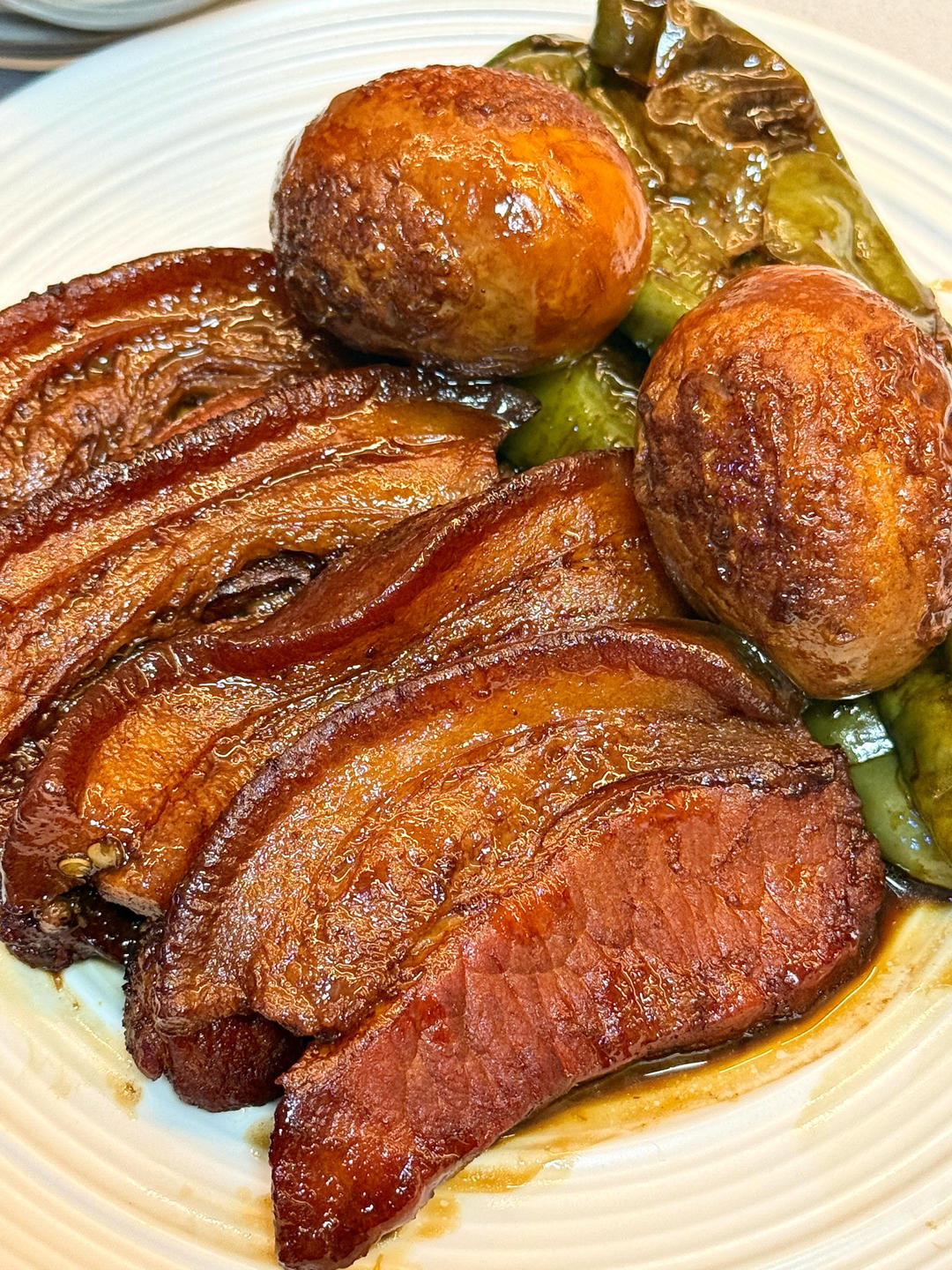
And if you want to see what mei gan cai can really do when paired with pork belly, mei cai kou rou is the canonical version — steamed, sliced, and meltingly tender. mei cai kou rou
3Classic Mei Cai Kou Rou (Pork Belly with Preserved Greens)A square of pork belly is boiled, lacquered in dark soy, fried until the skin blisters, then pressure-cooked with preserved mustard greens until the meat melts. The classic Cantonese banquet dish, inverted onto the plate for serving.Check out this recipe
Ingredient Notes
Pork trotters (猪蹄): Ask your butcher to split them lengthwise — this exposes the marrow and helps them cook evenly. Look for trotters with clean, pale skin and no off smell. If you can only find pork hock or pork knuckle, those work too, but the cooking time will be longer. For a deeper dive into the differences, see our guide to pork knuckle vs pork hock.
Preserved mustard greens (梅干菜 / mei gan cai): These are dried, salted, fermented mustard greens sold in vacuum packs or loose at Chinese groceries. They’re intensely salty and need a long soak — at least 4 hours, ideally overnight — with a few changes of water. After soaking, squeeze them dry. If you can’t find mei gan cai, you can substitute dried mustard greens or even rehydrated shiitake mushrooms for a different but still delicious result. For another way to use them, try our steamed pork ribs with preserved mustard greens.
Rock sugar (冰糖): Yellow rock sugar is traditional for caramelizing because it gives a cleaner, more mellow sweetness than white sugar. If you only have white rock sugar or granulated sugar, that works too — just watch the caramel closely so it doesn’t burn.
Aromatics: Star anise, cinnamon bark, bay leaves, white peppercorns, and white angelica powder (白芷粉) are the backbone of the braise. White angelica is optional but adds a distinctive herbal note that I love. If you don’t have it, the dish is still excellent without it.
Light and dark soy sauce: Light soy sauce seasons, dark soy sauce colors. Don’t swap one for the other — you’ll either end up with a pale dish or an overly salty one. For a gluten-free version, use tamari in place of both.
Green chilies: Optional, added at the end for color and a little heat. They don’t make the dish spicy, just brighten it up.
Ingredients
Here’s everything you’ll need for this braised pork trotters with preserved mustard greens recipe. Full measurements are in the recipe card below.
- 2 lb pork trotters (about 1kg), split, skin on
- 4 slices fresh ginger
- 1 whole scallion, knotted
- 1 star anise
- 1 small piece cinnamon bark (about 1 inch)
- 3 bay leaves
- 1 tsp white peppercorns
- 1/2 tsp white angelica powder (bai zhi powder, optional)
- 2 tbsp yellow rock sugar
- 2 tbsp light soy sauce
- 1 tbsp dark soy sauce
- 4 cups hot water, plus more as needed
- 2 cups preserved mustard greens (mei gan cai), soaked and squeezed dry
- Optional: a few sliced hot green chilies, for garnish
Equipment Needed
You don’t need much for this dish — a wok, a cutting board, and a slotted spoon will get you most of the way. Here’s what I use:
- Wok or heavy-bottomed pot: A wok is traditional and gives you plenty of surface area for caramelizing the trotters. A Dutch oven or heavy pot works just as well.
- Cutting board: For prepping the aromatics and the greens.
- Slotted spoon: For lifting the blanched trotters out of the water and for stirring the braise.
- Small pot: For blanching the trotters before braising.
- Measuring spoons and cups: For the soy sauces and water.
If you have a pressure cooker or Instant Pot, you can cut the braising time significantly — see the Variations section below. For a similar dish made in an Instant Pot, check out our braised pork with preserved mustard greens.
Why This Recipe Works
This recipe works because it layers flavor at every stage. The cold-water blanch removes impurities and any gamey smell from the trotters, giving you a clean base. The rock sugar caramel coats each piece of pork in a glossy, amber glaze that deepens the color and adds a mellow sweetness. The aromatics — star anise, cinnamon, bay, white pepper, and white angelica — build a fragrant, warming backbone that perfumes the whole pot. And the preserved mustard greens, added near the end, soak up the soy-and-caramel braising liquid and turn silky and intensely savory.
The long, gentle simmer is what makes the trotters tender. Collagen in the skin and connective tissue breaks down into gelatin, which gives the sauce its sticky, lip-smacking texture. If you rush it with high heat, the skin tears and the meat stays tough. Low and slow is the whole game.
Why does braising make pork trotters so tender? Collagen — the main protein in skin and connective tissue — denatures and converts to gelatin when held at a gentle simmer (around 190–205°F / 88–96°C) for a long time. That conversion is what gives the meat its fall-off-the-bone texture and the sauce its glossy, sticky body. The science of braising
Prep & Mise en Place
Before you turn on the heat, get everything ready. This dish moves fast once the wok is hot, and having your aromatics prepped makes the whole process smoother.
- Soak the greens: Rinse the preserved mustard greens under cold water, then soak them in a large bowl of cold water for at least 4 hours, ideally overnight. Change the water 2–3 times. When they’re ready, squeeze them dry and roughly chop them.
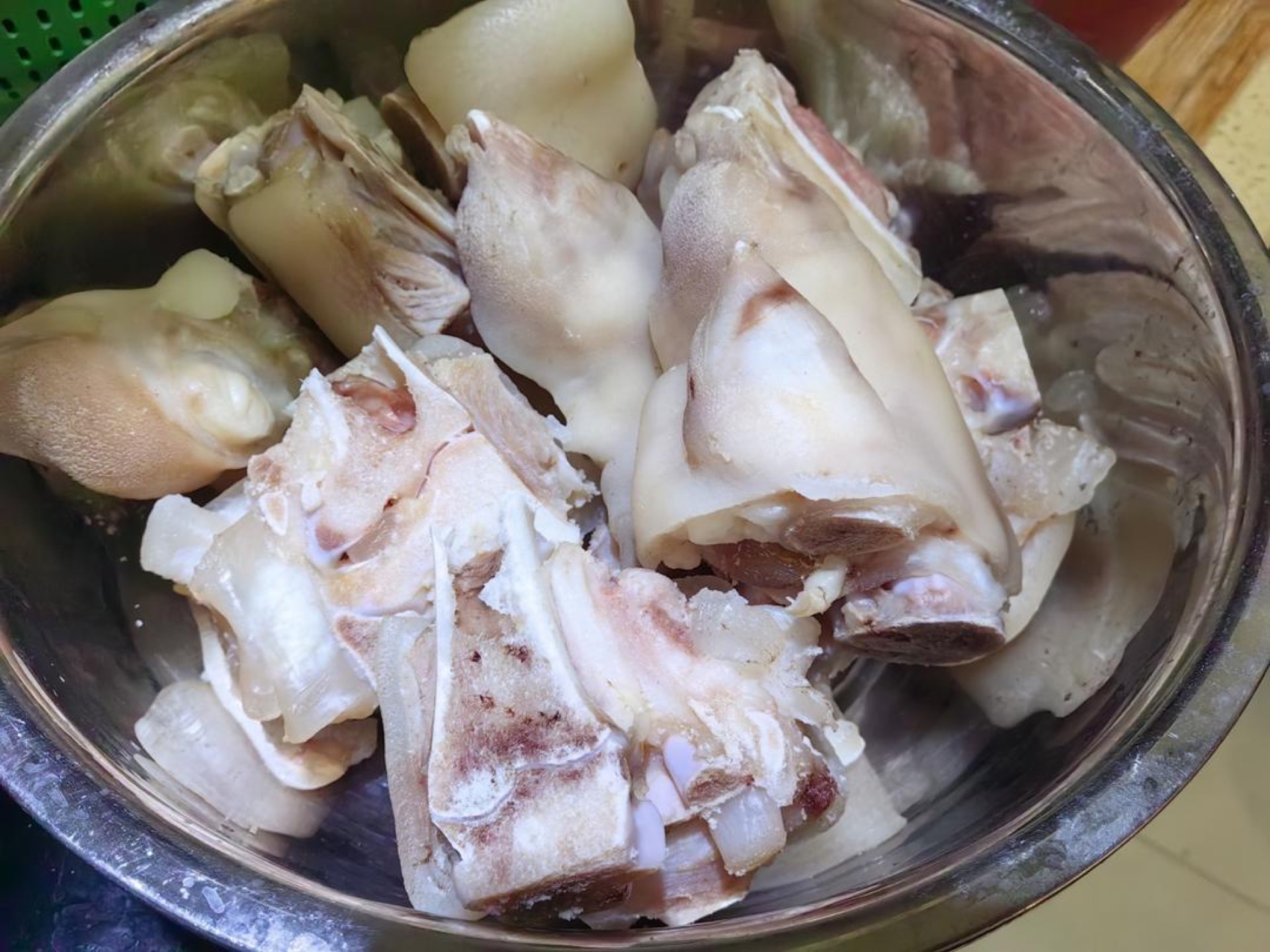
- Blanch the trotters: Add the trotters to a pot of cold water with a few slices of ginger. Bring to a boil and blanch for 5 minutes. Drain, rinse, and set aside.
- Prep the aromatics: Slice the ginger, knot the scallion, and measure out the star anise, cinnamon bark, bay leaves, white peppercorns, and white angelica powder.
- Measure the sauces: Combine the light soy sauce and dark soy sauce in a small bowl.
- Heat the water: Have 4 cups of hot water ready — adding cold water to a hot braise will toughen the meat.
Once everything is prepped, you’re ready to cook. The whole process takes about 2 hours from start to finish, but most of that is hands-off braising time.
Cooking Process
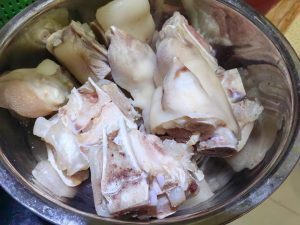
Step 1 — Blanch the Trotters
Add the pork trotters to a pot of cold water with a few slices of ginger, bring to a boil, and blanch for 5 minutes to remove impurities. Drain and rinse the trotters clean.
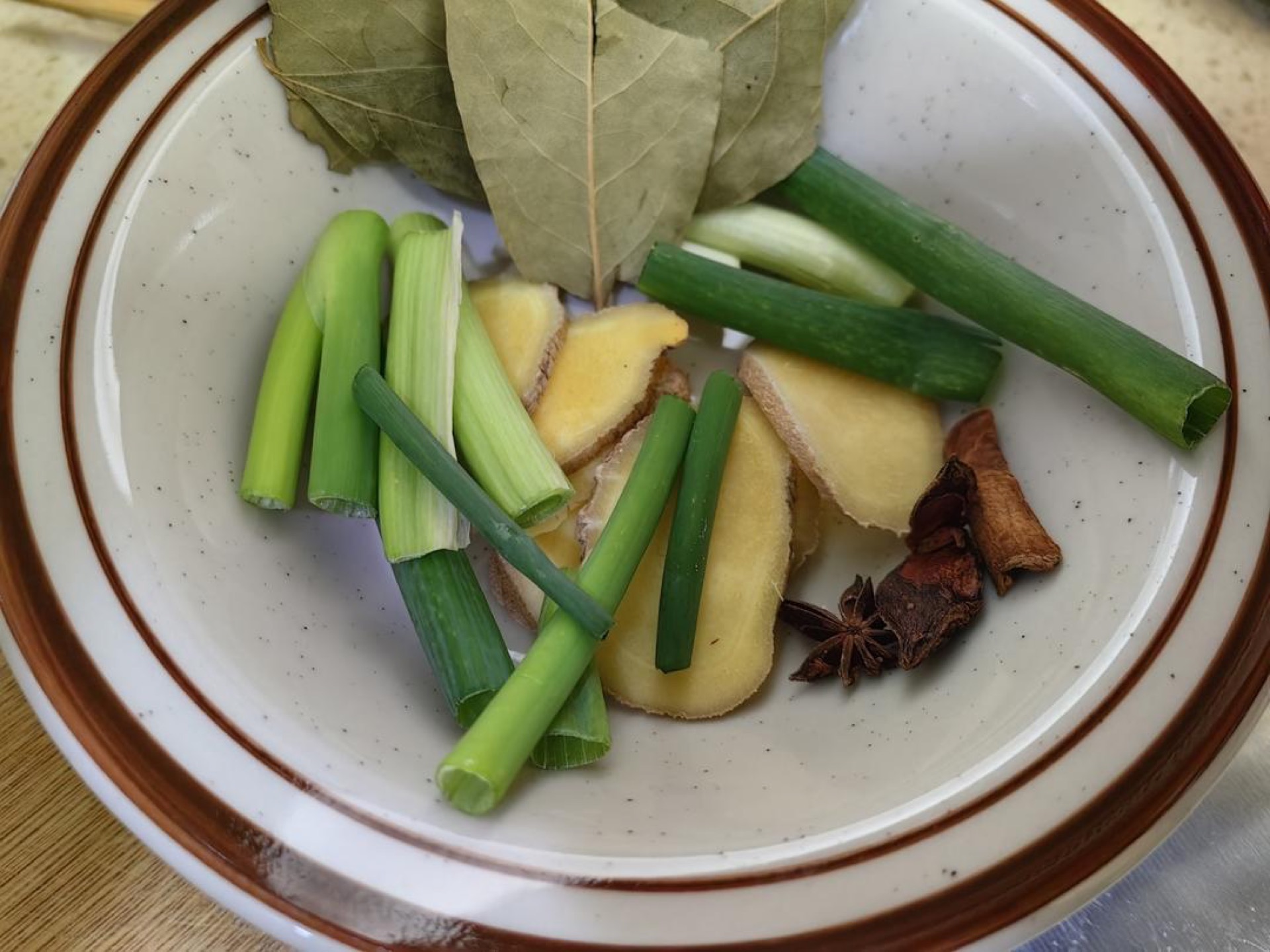
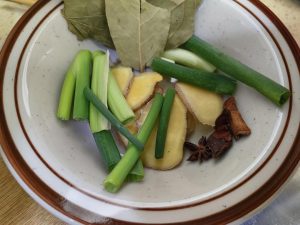
Step 2 — Gather the Aromatics
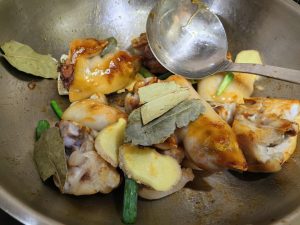
Prepare the aromatics: a whole scallion, extra ginger slices, one star anise, a small piece of cinnamon bark, several bay leaves, white peppercorns, and a generous pinch of white angelica powder.
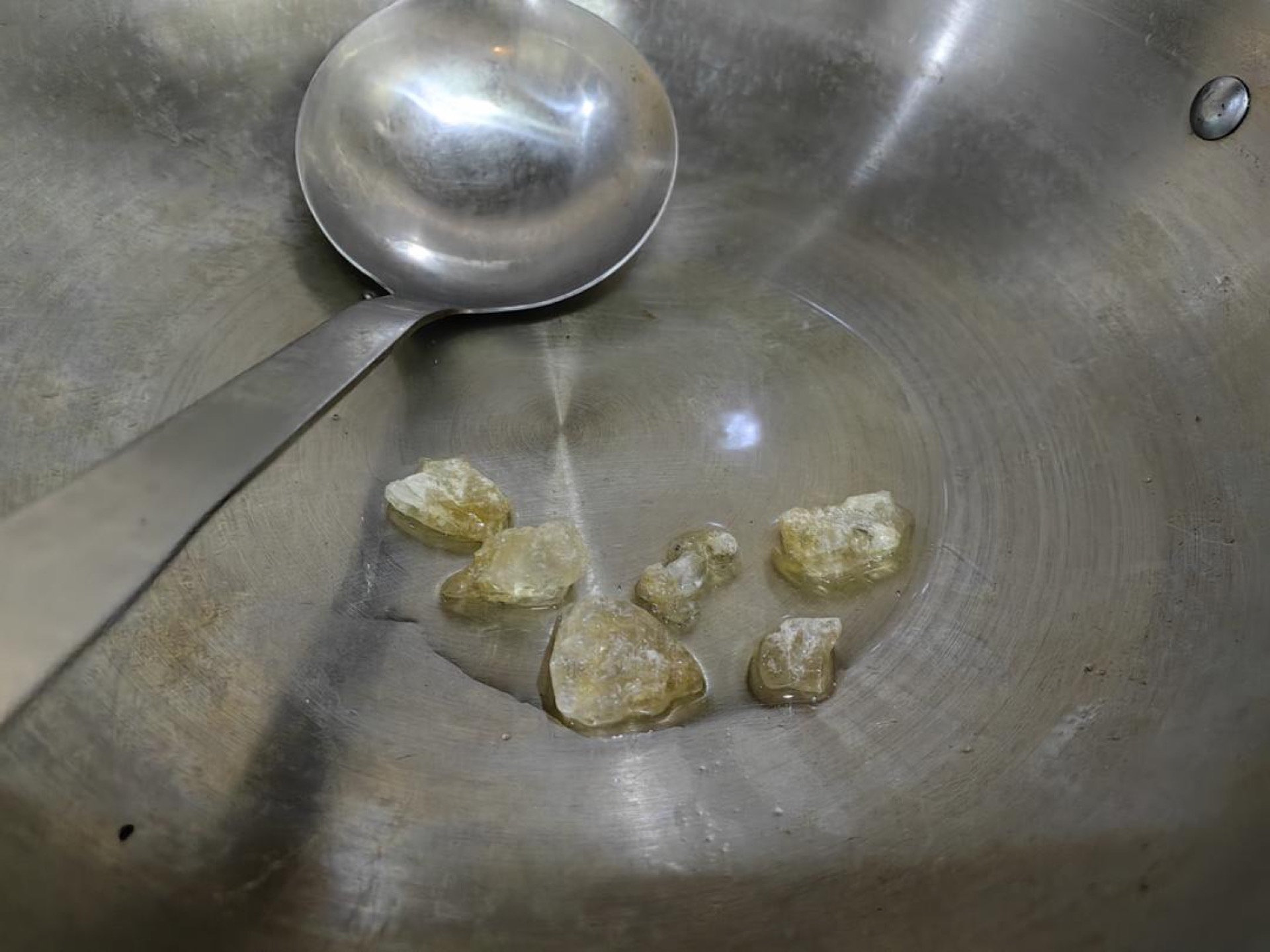
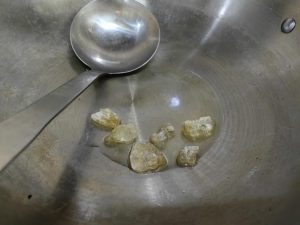
Step 3 — Melt the Rock Sugar
Heat a little oil in a wok over medium-low heat, add the yellow rock sugar, and stir gently until it melts into a golden caramel.
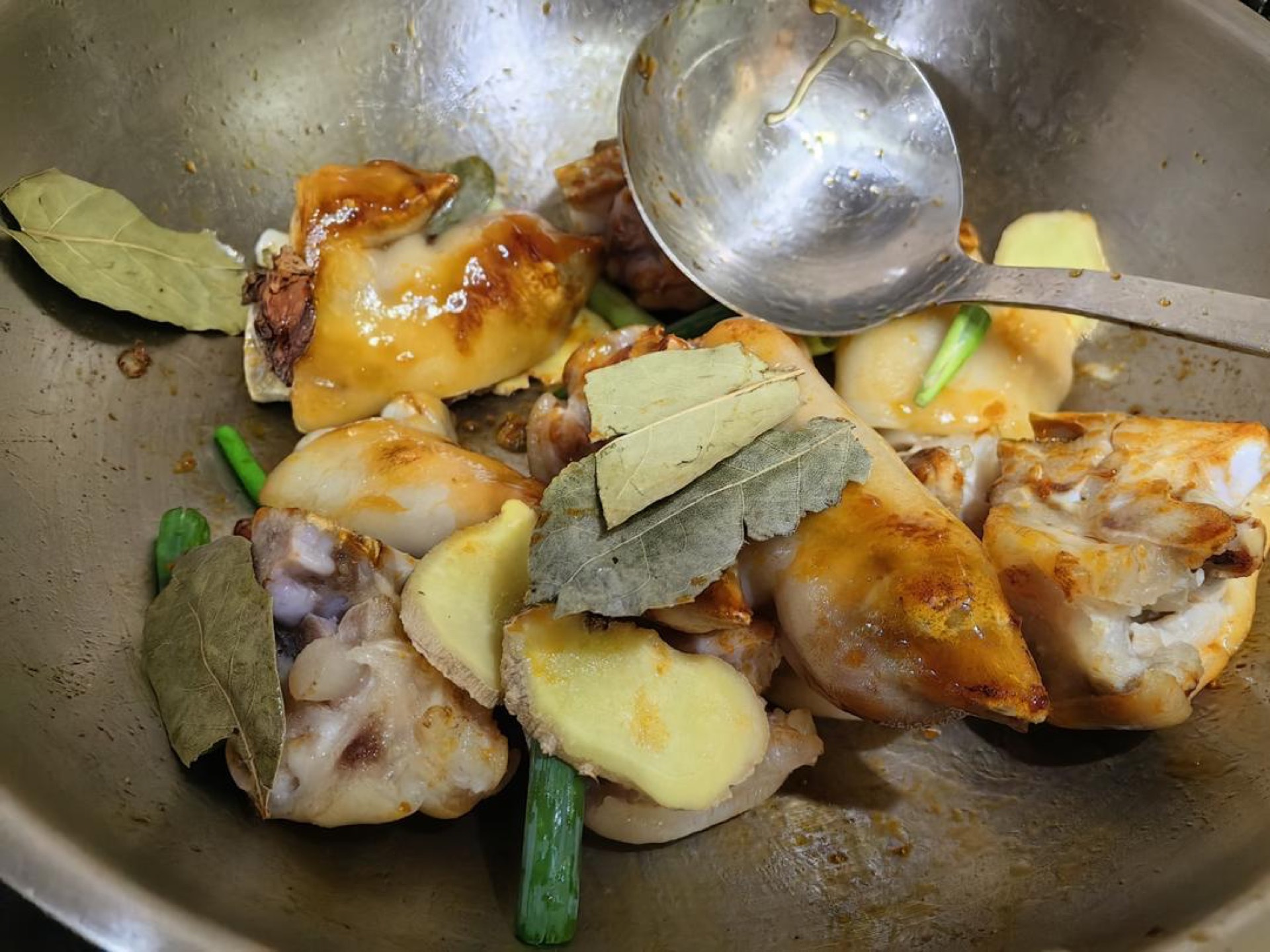
Step 4 — Coat the Trotters
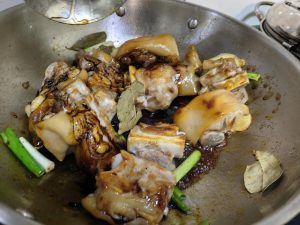
Add the blanched trotters to the wok and toss to coat them evenly in the caramel until they take on a deep amber color, then add all the aromatics.
Step 5 — Add the Soy Sauces
Pour in the light soy sauce and dark soy sauce, stirring to coat the trotters evenly.
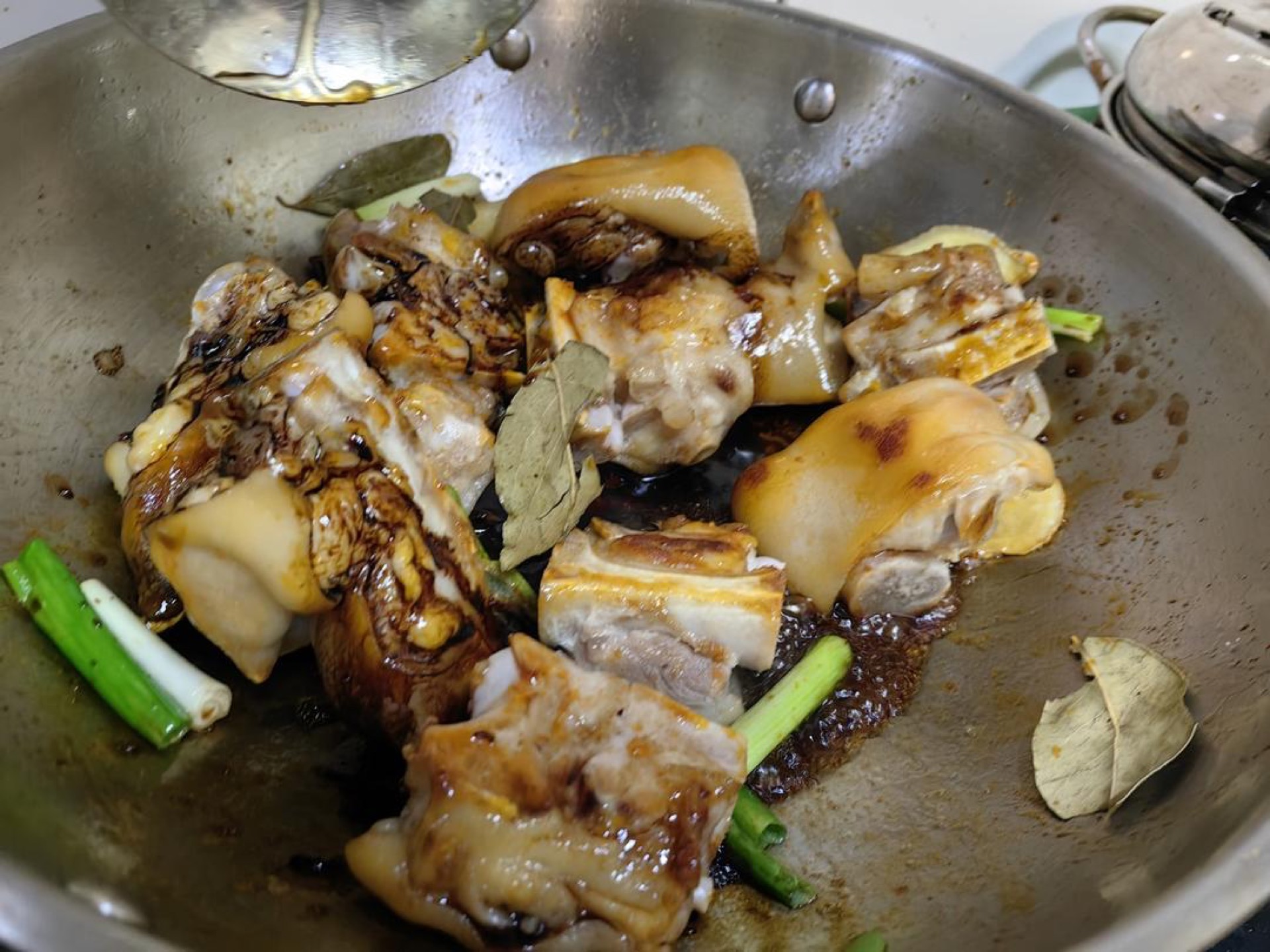
Step 6 — Braise with the Greens
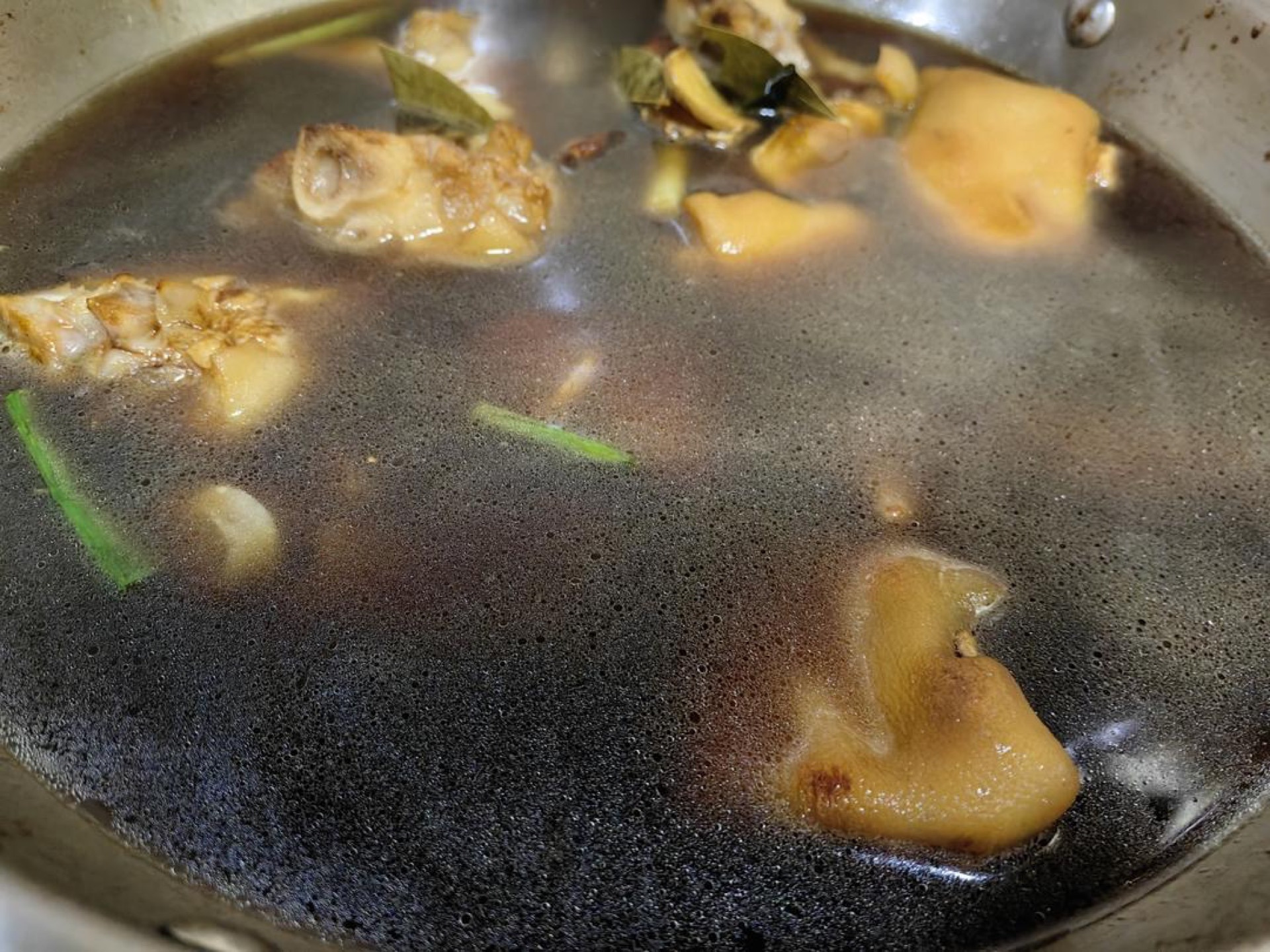
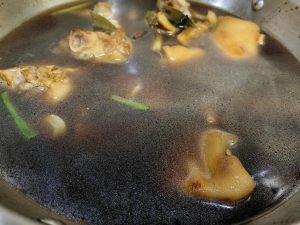
After a few minutes the color deepens; add hot water to cover, simmer for 1.5 hours, then add the soaked and squeezed-dry preserved mustard greens and simmer another 20 minutes.
Step 7 — Finish with Chilies
Add a few sliced hot green chilies for color and a little heat, simmer briefly, and serve.
Common Mistakes When Making Braised Pork Trotters with Preserved Mustard Greens
1. Skipping the blanch. If you skip blanching, the trotters will release scum and impurities into the braising liquid, giving the sauce a muddy flavor and an unpleasant smell. Fix: Always blanch in cold water with ginger for 5 minutes, then rinse well.
2. Burning the rock sugar. Rock sugar goes from golden caramel to bitter burnt sugar in seconds. Fix: Use medium-low heat, stir constantly, and pull the wok off the heat the moment the sugar melts into a deep amber color.
3. Adding cold water to the braise. Cold water shocks the meat and can make it tough. Fix: Always use hot water — keep a kettle or pot of hot water nearby.
4. Not soaking the greens long enough. Preserved mustard greens are very salty. If you don’t soak them long enough, the dish will be overpoweringly salty. Fix: Soak for at least 4 hours, ideally overnight, and taste a strand before adding — it should be pleasantly salty, not harsh.
5. Boiling instead of simmering. A rolling boil tears the skin and makes the meat tough. Fix: Keep the braise at a gentle simmer — small bubbles, not a roiling boil. If the liquid reduces too much, add more hot water.
6. Adding the greens too early. If you add the greens at the start, they’ll disintegrate into the sauce. Fix: Add them in the last 20 minutes of braising so they hold their texture and absorb the flavor without falling apart.
7. Underseasoning the sauce. The greens soak up a lot of salt, so the braising liquid needs to be well-seasoned. Fix: Taste the sauce before adding the greens and adjust with more soy sauce if needed.
Variations
Pressure cooker version: If you have a pressure cooker or Instant Pot, you can cut the braising time from 1.5 hours to about 30 minutes. Follow the recipe through step 5, then transfer everything to the pressure cooker, add the hot water, and cook on high pressure for 30 minutes. Release the pressure naturally, then add the soaked greens and simmer for 20 minutes on the sauté setting.
With pork belly instead of trotters: If you can’t find trotters, pork belly works beautifully. Cut it into 1-inch cubes and follow the same method, but reduce the braising time to about 1 hour. For a classic version, try our braised pork belly.
Spicier version: Add 2–3 dried red chilies to the aromatics, or finish with more sliced green chilies. For a spicy pork knuckle dish, try our spicy ginger pork knuckle.
With dried mushrooms: Add a handful of rehydrated shiitake mushrooms along with the greens for an extra layer of umami.
Red braised version: For a more classic red-braised flavor profile, try our red braised pork trotters, which uses a similar technique with a slightly different aromatic profile.
Frequently Asked Questions
Can I use pork hock instead of pork trotters? Yes — pork hock is essentially the upper part of the leg and works well in this recipe. It has more meat and less skin, so the sauce will be slightly less gelatinous. Increase the braising time by about 30 minutes. For more on the differences, see our guide to pork knuckle vs pork hock.
How do I know when the trotters are done? The meat should be fall-off-the-bone tender and the skin should be soft and jiggly. A chopstick should slide through the thickest part with little resistance. If it’s still tough, keep simmering and check every 15 minutes.
Can I make this dish ahead of time? Yes — it actually tastes better the next day. Cool it completely, then refrigerate for up to 4 days. The fat will solidify on top, making it easy to remove if you prefer a leaner sauce. Reheat gently on the stovetop with a splash of water.
What if I can’t find preserved mustard greens? You can substitute dried mustard greens, or use rehydrated shiitake mushrooms for a different but still delicious result. The flavor won’t be identical, but it will still be savory and satisfying.
Is this dish spicy? No — the green chilies are added for color and a mild freshness, not heat. If you want spice, add dried red chilies to the aromatics.
How to Serve
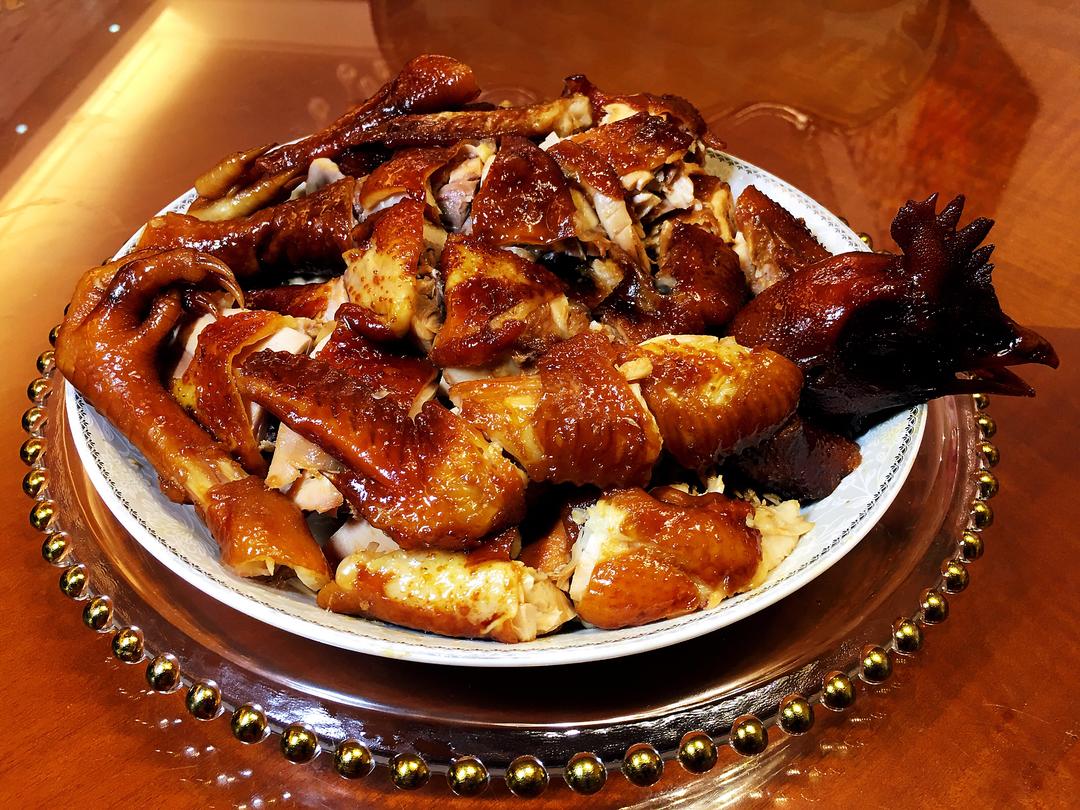
Braised pork trotters with preserved mustard greens is traditionally served with plain steamed white rice, which soaks up the sticky, savory sauce. A simple stir-fried green vegetable — like bok choy or gai lan — balances the richness. If you want to go all-out, serve it alongside cantonese soy sauce chicken for a Cantonese-style feast.
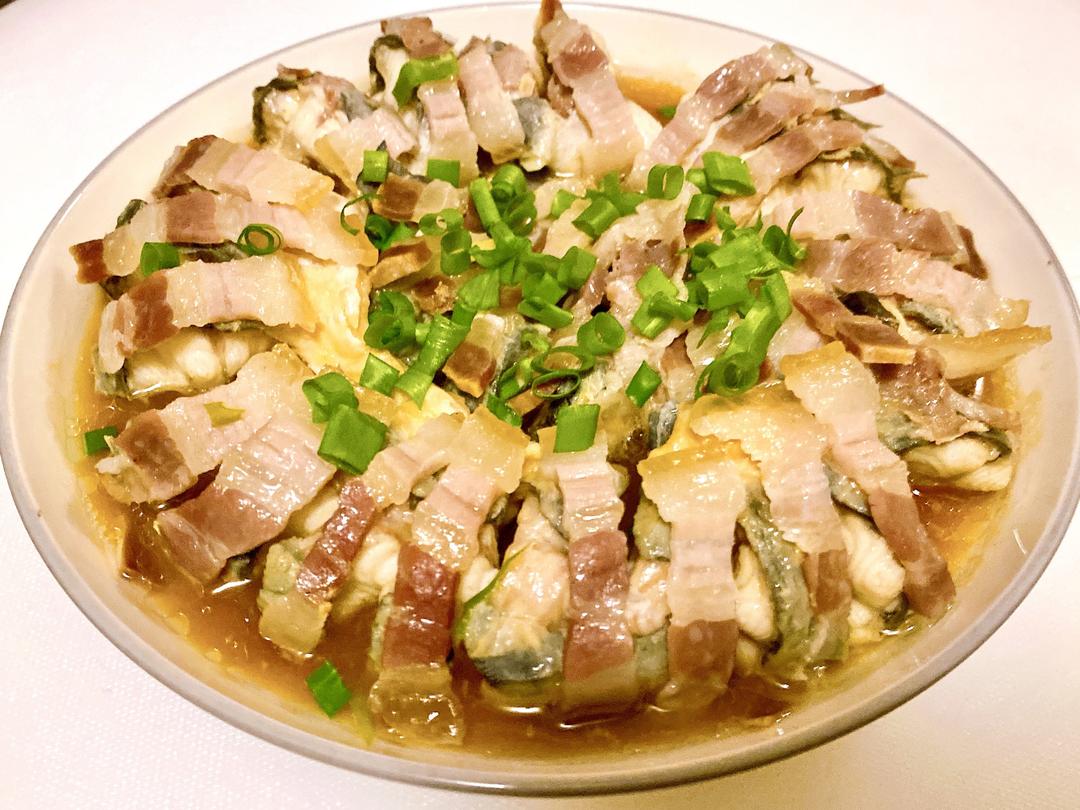
For a lighter, contrasting side, steamed eel with pork is a classic Jiangnan pairing that echoes the savory, umami-rich flavors of the trotters. And if you want a sweet finish, crispy sticky rice apple cakes make a lovely dessert to round out the meal.

Storage & Reheat
Store leftovers in an airtight container in the refrigerator for up to 4 days. The dish actually improves overnight as the flavors meld. To reheat, transfer to a pot or wok with a splash of water and warm gently over medium-low heat until steaming hot throughout. You can also reheat individual portions in the microwave, covered, for 2–3 minutes.
To freeze, cool completely, then transfer to a freezer-safe container and freeze for up to 3 months. Thaw overnight in the refrigerator before reheating. Note that the texture of the greens may soften slightly after freezing, but the flavor will still be excellent.
If you have a lot of sauce left over, don’t discard it — it’s delicious spooned over rice or noodles, or used as a braising liquid for tofu or eggs.
Allergen Notice
This recipe contains soy (from the light and dark soy sauce). If you’re gluten-sensitive, use tamari instead of standard soy sauce. Always check the labels on your preserved mustard greens, as some brands may contain added allergens. If you have a soy allergy, this dish may not be suitable for you.
Nutrition Disclaimer
Nutrition information is calculated using an ingredient database and should be considered an estimate. In cases where multiple ingredient alternatives are given, the first listed is calculated for nutrition. Garnishes and optional ingredients are not included.
About the Author & Recipe Development
Hi, I’m Lin — the cook, writer, and photographer behind Woks of Love. I grew up in a Chinese household where the wok was always on the stove and dinner was never just one dish. I started this site to share the homestyle recipes I grew up with, the ones that don’t always make it into restaurants but are the heart of everyday Chinese cooking.
This braised pork trotters with preserved mustard greens recipe is based on the version my family has made for years, with a few tweaks I’ve picked up along the way — extra ginger, a heavier hand with the bay leaves, and a spoonful of white angelica powder because I love the fragrance. I’ve tested it many times to get the balance of salty, sweet, and savory just right, and I hope it becomes a favorite in your kitchen too.
If you make this dish, I’d love to hear how it turns out. Leave a comment below, or tag me on social media — I’m always happy to see what you’re cooking.
Authoritative References
For safe cooking temperatures and food safety guidance, see the USDA safe temperature chart. For more on the science of braising and collagen conversion, see Serious Eats’ guide to braising. For general food safety and storage guidelines, see the FDA Food Code.
Braised Pork Trotters with Preserved Mustard Greens (梅干菜猪蹄): A Deeply Savory Chinese Classic

Equipment
- Wok
- Cutting Board
- Slotted Spoon
Ingredients
For the Pork Trotters
- 2 lb pork trotters about 1kg, split, skin on
- 4 slices ginger fresh
- 1 whole scallion knotted
For the Braising Aromatics
- 1 star star anise
- 1 small piece cinnamon bark about 1 inch
- 3 leaves bay leaves
- 1 tsp white peppercorns
- 1/2 tsp white angelica powder bai zhi powder, optional
For the Braising Liquid
- 2 tbsp rock sugar yellow rock sugar preferred
- 2 tbsp light soy sauce
- 1 tbsp dark soy sauce
- 4 cups hot water plus more as needed
For the Preserved Mustard Greens
- 2 cups preserved mustard greens mei gan cai, soaked and squeezed dry
Instructions
- Add the pork trotters to a pot of cold water with a few slices of ginger, bring to a boil, and blanch for 5 minutes to remove impurities. Drain and rinse the trotters clean.

- Prepare the aromatics: a whole scallion, extra ginger slices, one star anise, a small piece of cinnamon bark, several bay leaves, white peppercorns, and a generous pinch of white angelica powder.
- Heat a little oil in a wok over medium-low heat, add the yellow rock sugar, and stir gently until it melts into a golden caramel.
- Add the blanched trotters to the wok and toss to coat them evenly in the caramel until they take on a deep amber color, then add all the aromatics.
- Pour in the light soy sauce and dark soy sauce, stirring to coat the trotters evenly.
- After a few minutes the color deepens; add hot water to cover, simmer for 1.5 hours, then add the soaked and squeezed-dry preserved mustard greens and simmer another 20 minutes.
- Add a few sliced hot green chilies for color and a little heat, simmer briefly, and serve.












Leave a Reply