Hey there! Welcome back to my kitchen.
If you’ve ever followed a recipe to the letter, flavored it perfectly, but ended up chewing on a piece of meat that felt like an old rubber boot, I feel your pain. Growing up in my parents’ loud, chaotic restaurant in Chengdu, the rhythmic thud-thud-thud of cleavers hitting the chopping blocks was the soundtrack of my childhood.
I used to watch the chefs break down massive cuts of meat with surgical precision. When I went to culinary school and later worked in high-pressure kitchens for a decade, I learned the scientific “why” behind those movements.
Let’s be real: The most expensive cut of meat can be ruined by a bad knife, and a humble cut like pork tenderloin can taste like luxury if you treat it right. Today, we are going deep into prep. No secrets held back. I’m going to show you how to respect the ingredient so your next stir-fry is melt-in-your-mouth tender.
Why This Matters (The Science)
You might think, “Lin, it’s just cutting meat, does it matter?” Trust me, it does.
Pork tenderloin is lean. It doesn’t have the high fat content of Pork Belly to hide mistakes. When we cut meat for Chinese cooking—especially for quick, high-heat stir-fries—we are manipulating the muscle fibers to ensure they break down quickly and absorb flavor. If you cut it wrong, the fibers contract into tight coils, squeezing out the moisture. Cut it right, and it stays juicy.
Mistake #1: Ignoring the Silver Skin
The first thing you’ll notice on a whole tenderloin is a patch of pearlescent white membrane running down one side. This is the silver skin (elastin).
In culinary school, this was the first test of patience. Unlike fat, which renders down and adds flavor, silver skin does not melt. It shrinks when cooked, curling your meat and turning into something akin to dental floss in your finished dish. You must remove it.

How to fix it: Slide the tip of your knife under the silver skin to create a small tab. Hold that tab tight with one hand, and slide your knife blade underneath it, angling the sharp edge slightly upward against the skin. Glide the knife down the length of the loin.
Mistake #2: Cutting With the Grain
This is the cardinal sin of butchery. Meat is made of bundles of muscle fibers, like a rope. If you cut with the grain, you are serving your guests long strands of rope that their teeth have to grind through.
We want to cut against the grain. This snips those long fibers into short, manageable pieces that separate easily when chewed. This is the secret to why the meat in my Pork Stir-fry with Green Peppers is so tender, even though it cooks in under three minutes.
How to Identify the Grain
Look closely at the meat. You will see lines running lengthwise down the tenderloin. You want your knife to be perpendicular (forming a ‘T’ shape) to those lines.
Mistake #3: Inconsistent Thickness (The “Wok Killer”)
In a Western kitchen, you might be roasting a whole loin in the oven where precise thickness matters less. But in a wok? Speed is everything. If one slice is thin and another is chunky, the thin one will dry out like cardboard before the thick one is safe to eat.
We are aiming for uniformity.
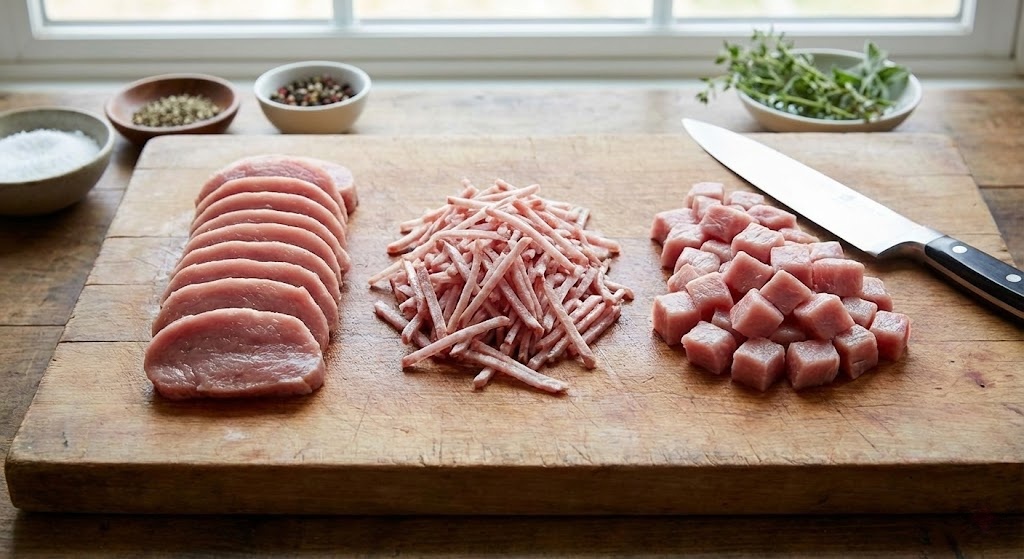
- For Stir-fries: You generally want slices about 1/8 to 1/4 inch thick.
- For Shreds (Julienne): First cut thin slices, then stack them like a deck of cards and slice them again into matchsticks. This is the classic cut for dishes like Fish-Fragrant Pork Stir-fry (Yu Xiang Rou Si).
The “Chef’s Cut”: Step-by-Step
Here is how I process a tenderloin from start to finish.
- Freeze it briefly: This is a pro tip I use constantly. Put the fresh tenderloin in the freezer for about 20–30 minutes before cutting. It firms up the meat, making it much easier to slice thinly without it squishing under your knife.
- Trim: Remove that silver skin we talked about.
- Section it: I usually cut the long tenderloin into 2 or 3 manageable logs.
- The Slice: Angle your knife at 45 degrees (a “bias cut”). This increases the surface area of each slice, meaning more room for the marinade to coat.

Once you have your perfect slices, you aren’t done! You need to marinate them. This usually involves Dark Soy Sauce for color, cooking wine, and cornstarch. This technique, known as “velveting,” seals the juices in.
If you want to practice your slicing on a different protein, the same logic applies to beef. Try my Hunan Stir-fried Beef—if you cut the beef with the grain there, your jaw will get a workout!
Dealing with the “Tail” and “Head”
A tenderloin isn’t a perfect cylinder. It has a thick head and a skinny, tapered tail.
- The Head: This is great for cutting larger, medallions or slicing for dishes like Sichuan Boiled Pork Slices (Shui Zhu Rou Pian), where broad, thin sheets of meat are poached in spicy broth.
- The Tail: Because it’s narrow, I usually save this for “dicing.” I cut the tail into small cubes for dishes like Mapo Tofu (if using pork instead of beef) or for a quick fried rice.
Final Thoughts
The way you cut your meat is the difference between “takeout quality” and “restaurant quality.” It takes a little practice to get those slices uniform, but don’t give up.
Once your prep is done, you are ready to cook. Maybe you want something crispy and sweet? These chunks are perfect for Sweet and Sour Pork. Or, if you want to spice things up, grab some Homemade Chinese Chili Oil and get that wok smoking hot.
Now, grab your sharpest knife and get to work!
Authoritative References
- USDA Food Safety and Inspection Service: Fresh Pork from Farm to Table – For official guidelines on safe handling temperatures and cut identification.
- Exploratorium – Science of Cooking: Muscle Fibers and Texture – A breakdown of how cutting against the grain affects the physical structure of meat proteins.
- Pork.org: Pork Cuts Guide – Detailed diagrams and best cooking methods for different sections of the pig.








Leave a Reply