Hey there! Welcome back to my kitchen.
If you grew up in the West, you might know pork hock (or pork knuckle) as that smoked thing you throw into pea soup. But in the loud, chaotic Sichuan restaurant where I grew up—my childhood “playground”—pork hock was royalty. We call it Pang Ti or Zhouzi. When it’s done right, it is a glistening, trembling mound of mahogany-red meat that literally melts on your tongue.

But let’s be real: staring at a giant raw pork joint in your kitchen can be intimidating. It has skin, bones, and yes… sometimes hair.
I’ve spent years in professional kitchens and backpacked from Xi’an to Guangzhou learning how different regions handle this cut. Today, I’m breaking down the science and the soul of cooking pork hock. No secrets held back. I’m going to teach you how to prep it so it’s clean and odorless, and how to braise it until it’s so tender you can eat it with a spoon.
Trust me, once you master this, you’ll never look at a “ham hock” the same way again.
Why This Cut is Special (The Culinary Logic)
Pork hock is the joint between the tibia/fibula and the metatarsals of the pig’s foot. It is loaded with connective tissue and collagen.
In culinary school, we learned that collagen is tough. But when you subject it to low, wet heat (braising) over a long period, it hydrolyzes into gelatin. That is the secret. That sticky, lip-smacking texture you get in a great Dongpo Ginger Pork Knuckle isn’t fat—it’s gelatin. It gives the sauce body and makes the meat succulent.
Western Kitchen Reality: Most Western supermarkets sell “Ham Hocks,” which are cured and smoked. Do not use those for Chinese braising. You need fresh, uncured pork hocks. If you can’t find them at a regular grocer, check a local butcher or an Asian market. You want the skin on and the bone in.
Part 1: The Prep (Don’t Skip This!)
The difference between a restaurant-quality dish and a “gamey” home disaster is the prep. This is where we remove the “funk.”
1. The Shave
Inspect the skin. Even if it looks clean, run your hand over it. If you feel stubble, you need to remove it.
- The Pro Method: Use a culinary torch to singe the hairs off. It adds a slight smoky flavor and cleans the skin perfectly.
- The Home Method: A clean, unused disposable razor works wonders. Just shave it under warm water.
2. The Blanch
You cannot skip this. Blanching removes the hemoglobin (blood) and impurities that cloud your sauce and make the meat smell strange.
- Place the hock in a pot of cold water.
- Add a few slices of ginger and a heavy splash of Shaoxing Wine. The alcohol evaporates during boiling, taking the “porky” odor with it.
- Bring to a boil and let it roll for 5-8 minutes.

3. The Rinse
Take the hock out and wash it under warm running water. Scrub off any scum clinging to the skin. The skin should now feel firm and look pale.
Part 2: The Braise (The Art of Patience)
Now that your canvas is clean, it’s time to paint with flavor. Whether you are making a spicy Sichuan version or a sweeter style similar to Braised Pork Trotters, the technique remains the same.
The Aromatics
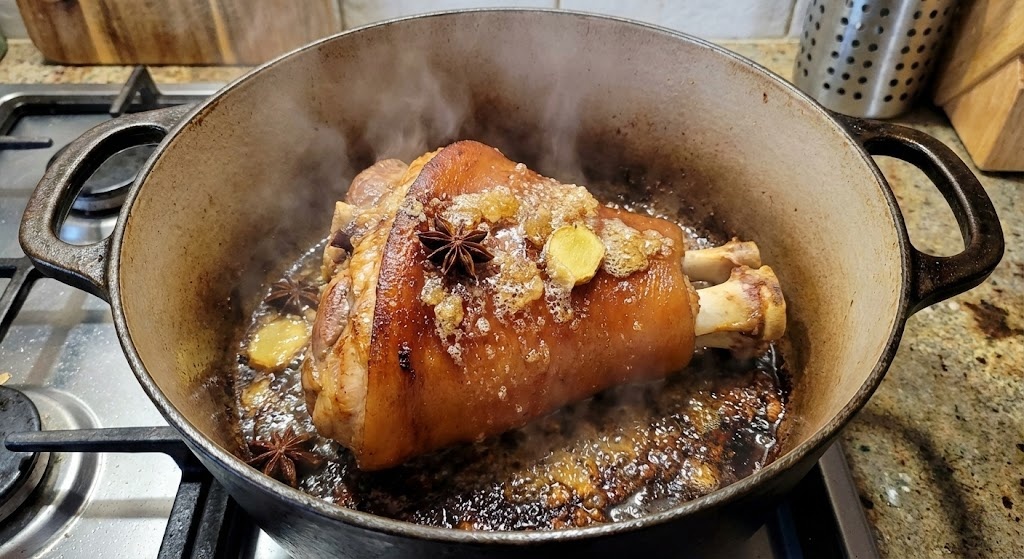
You need a base. In my heavy Dutch oven (which mimics the heat retention of a clay pot), I always sauté:
- Ginger & Scallion: The holy duo.
- Star Anise & Cassia Bark: For that signature warmth.
- Sichuan Peppercorns: Just a few, to cut the richness.
The Liquid Gold
The color of a perfect braise comes from the interaction of sugar and soy sauce.
- Sugar: I prefer rock sugar. It gives a glossy, jewel-like sheen that granulated sugar just can’t match.
- Soy Sauce: You need a mix. Light soy sauce for the saltiness (umami), and Dark Soy Sauce specifically for that deep, amber color.
The Simmer
Add water or stock to cover the hock about halfway. Bring it to a boil, then turn it down to the lowest setting. Cover it.
Sensory Cue: You don’t want a violent boil. You want a gentle “bloop… bloop… bloop.” If it boils too hard, the meat will be stringy and the skin will tear. If you are gentle, the skin will remain intact but become soft as jelly.
This usually takes 2.5 to 3 hours. If you are in a rush, a pressure cooker works (about 45 mins), but I swear the texture is better on the stove. It’s similar to how I cook my Red Wine Braised Beef—patience yields the best texture.
Part 3: Finishing and Serving
When is it done? Poke the thickest part of the skin with a chopstick. It should slide in with zero resistance, like poking through room-temperature butter.
If the sauce is too thin, remove the meat carefully (it will be fragile!) and crank up the heat to reduce the liquid until it’s a thick, shiny glaze.
What to Serve With It
Pork hock is rich. Extremely rich. You need balance.
- Carbs: Steamed white rice is non-negotiable to soak up that sauce.
- Greens: You need something crisp or acidic to cut through the collagen and fat. A plate of Stir-fried Lettuce with Garlic is traditional and perfect.
- Acid: If you want a cold appetizer alongside, try a Smashed Cucumber Salad. The vinegar and garlic provide a necessary palate cleanser.

Lin’s “No Secrets” Troubleshooting
- “My skin is rubbery!” It simply hasn’t cooked long enough. Put the lid back on and give it another 30 minutes. Collagen needs time to turn into gelatin.
- “It smells too strong.” Did you skip the blanching step? Or maybe you forgot the ginger? Next time, be generous with the cooking wine during the blanch.
- “The skin burst apart.” You boiled it too hard. Keep the heat on low—a gentle simmer is key to keeping that beautiful shape.
Braising a pork hock is a labor of love, but when you bring that massive, trembling, aromatic dish to the table, you look like a master chef.
Happy cooking, and let me know in the comments if you try this!
Authoritative References
- The Science of Collagen to Gelatin: For a deeper dive into why low and slow heat transforms tough cuts like pork hock, check out this guide on the science of stewing. https://www.seriouseats.com/science-of-stew-why-long-cooking-is-bad-idea-overcook-beef
- Understanding Cuts of Pork: To understand the difference between the hock, the trotter, and the shoulder, this breakdown is incredibly helpful for home cooks. https://www.thespruceeats.com/cuts-of-pork-pig-diagram-995306
- Traditional Chinese Braising Techniques: The Michelin Guide offers great insight into the “Red Braising” (Hong Shao) technique used for this dish. https://guide.michelin.com/en/article/dining-out/cooking-technique-red-braising



Leave a Reply