If you have ever prepared a stir fry at home only to find the meat tough, stringy, or unevenly cooked, the issue likely started before you even turned on the stove. In my ten years of training and cooking in professional kitchens in Chengdu, the very first skill we mastered wasn’t heat control or sauce balancing—it was the art of the cut.
How to cut meat for stir fry is the foundational pillar of Chinese stir fry technique. In regional Chinese cooking, we view the preparation of the protein as a way to “pre-program” the cooking process. Because stir-frying happens in a matter of minutes, the meat must be physically engineered to cook rapidly while retaining every drop of moisture.
Most beginners make the mistake of slicing meat too thick or, more critically, slicing in the same direction as the muscle fibers. This results in a “chewy” experience that no amount of sauce can fix. By mastering a few specific slicing principles, you can transform even budget-friendly supermarket cuts into restaurant-quality bites.
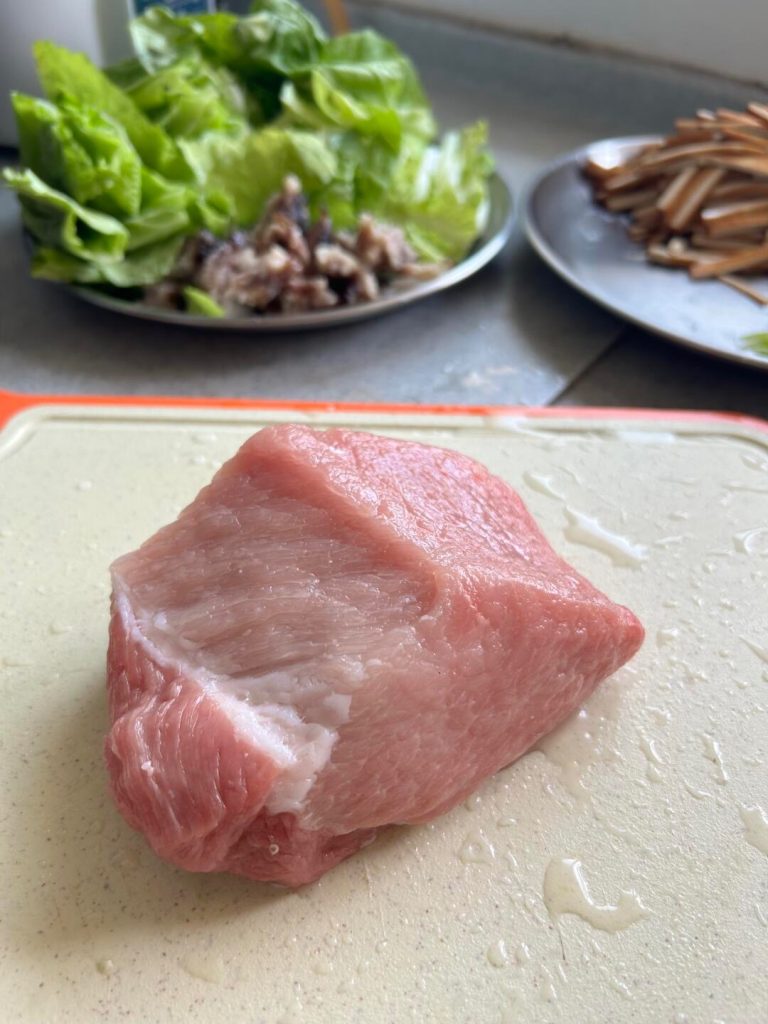
What This Technique Does (The Science)
The goal of professional slicing is to maximize tenderness and surface area. When we talk about “tenderness” in meat, we are essentially talking about the ease with which human teeth can break through muscle fibers.
- Breaking the Fiber Matrix: Meat is composed of long, parallel strands of muscle fiber. By slicing perpendicular to these fibers, you effectively shorten them. Instead of your teeth trying to tear through a long “rope” of protein, they only have to move through short, cross-sectioned “stubs,” making the meat feel melt-in-your-mouth tender.
- Surface Area and the Maillard Reaction: A standard Western home stove typically produces 10,000–18,000 BTU, which is significantly lower than a restaurant’s 80,000–120,000 BTU jet burner. By slicing meat thin—ideally between 1/8 and 1/4 inch (3mm–6mm)—we increase the surface-area-to-volume ratio. This allows for a rapid Maillard reaction (browning) before the internal proteins overcook and seize.
- Uniform Heat Transfer: Consistent thickness ensures that every piece of meat reaches the safe internal temperature at the exact same moment. This prevents the common frustration of having half your beef overcooked and dry while the larger pieces are still raw in the middle.
Key Principles to Get It Right
- Identify the Grain First: Before the knife touches the meat, look for the parallel lines running across the surface; this is the grain.
- The “Against the Grain” Rule: Your knife should always cut perpendicular to those lines, never parallel to them.
- Temperature Management: Meat is significantly easier to slice into uniform, paper-thin strips if it is partially frozen.
- Blade Angle: Use a “bias cut” (angling the knife at 45 degrees) to create wider slices with more surface area for the sauce to cling to.
Step-by-Step Method
1. The Firming Phase
Place your meat in the freezer for 30–45 minutes before slicing.
- Why it matters: Fresh meat is soft and “squishy,” making it difficult to maintain a consistent 1/8-inch thickness. Chilling firms the fat and protein, allowing the blade to glide through with precision.
2. Identify the Muscle Direction
Lay the meat on your cutting board and look for the direction of the muscle fibers.
- Why it matters: If you slice with the grain, you are leaving the long protein strands intact. No matter how fast you cook it, the result will be stringy. Identifying the grain is the only way to ensure you can cut across it.
3. Trim the Connective Tissue
Remove any “silver skin” or heavy gristle before slicing.
- Why it matters: Connective tissue does not break down during the 2–3 minutes of high-heat stir-frying. Leaving it on will cause the meat to curl and become unpleasantly rubbery.
4. Slice Against the Grain at an Angle
Position your knife perpendicular to the fibers and tilt the blade to a 45-degree angle relative to the cutting board.
- Why it matters: This creates a larger surface area on each slice. This is vital for dishes like Hunan Stir-fried Beef where the sauce needs to coat each piece quickly.
5. Maintain Uniformity
Aim for slices that are roughly the same length and thickness (1/8 inch is standard for home stoves).
- Why it matters: Uniformity compensates for the lower heat recovery time of a regular stove. It ensures that when the pan temperature drops after adding the meat, everything still cooks through at the same rate.
Common Mistakes When Slicing Meat
- Slicing with the Grain: This is the most common error. It results in tough meat. Fix: Always rotate the meat so the fibers run horizontally before you begin your vertical cuts.
- Using a Blunt Knife: A dull blade requires more pressure, which “crushes” the delicate muscle fibers rather than shearing them. Fix: Sharpen your knife before every major prep session.
- Slicing Meat at Room Temperature: This leads to jagged, uneven pieces. Fix: Use the 30-minute freezer trick mentioned above.
- Variable Thickness: Slicing some pieces at 1/4 inch and others at 1/2 inch. Fix: Practice slow, deliberate movements; speed comes only after you have mastered consistency.
Pro Tips from a Chinese Kitchen
- The Butterfly Cut: If you are working with a very thick piece of flank steak or chicken breast, slice it in half horizontally (but not all the way through) and “open it like a book” before slicing it into strips. This creates the perfect thinness for Beef Chow Fun.
- The Knife Heel Technique: In Chengdu, we often use the “heel” of the cleaver for the initial bite into the meat, then follow through with a smooth pushing motion. This prevents the meat from sliding on the board.
- Grain Shift: Be aware that the grain direction often changes in a single cut of meat (like a beef brisket or pork shoulder). Stop and re-evaluate the grain every few slices.
Ingredient and Tool Notes
The Tool: While a traditional Chinese cleaver (Cai Dao) is the gold standard for its weight and height, a sharp Western Chef’s knife or a Santoku works perfectly well for this technique. Avoid serrated blades, as they “saw” the meat and ruin the texture.
The Stove: On a standard Western gas or electric stove, pan recovery time is slow. Because of this, your slices must be slightly thinner than what you might see in a restaurant. This ensures the meat is fully seared before the pan loses too much heat and begins to steam the protein.
Substitutions: If you are uncomfortable with raw beef, you can practice this technique on firm tofu. While tofu doesn’t have a “grain” in the biological sense, practicing uniform 1/4-inch slices is excellent for mastering Authentic Mapo Tofu.
Variations / When to Use This Technique
- Beef: Apply this to Flank Steak, Sirloin, or Skirt Steak. This is the secret to Authentic Beef and Broccoli.
- Chicken: Use this for Homestyle Kung Pao Chicken. For chicken breast, the bias cut is essential to prevent it from drying out.
- Pork: Best used on pork tenderloin or loin for dishes like Pork and Celery Stir-fry.
FAQ Section
Can I skip the freezing step?
You can, but it is much harder to get professional, paper-thin slices. If you have excellent knife skills, you may skip it, but for most home cooks, the freezer is your best friend.
Can I do this without a wok?
Yes. Since the meat is sliced correctly for fast cooking, a large flat-bottomed skillet or cast-iron pan will work beautifully on a regular stove.
How long should I marinate after cutting?
Once sliced, I recommend a 15–20 minute marinade. This allows the seasonings to penetrate the increased surface area you’ve created.
What happens if I cut the meat too thin?
If the meat is “shaved” (thinner than 1/8 inch), it may disintegrate in the pan. Aim for a thickness that feels substantial but delicate.
Sources & Standards Referenced
- USDA Food Safety and Inspection Service: Safe Minimum Internal Temperature Chart (145°F for beef/pork, 165°F for poultry). Specific Guidelines Here
- Harvard T.H. Chan School of Public Health: Cooking Oils and Smoke Points (Recommended high-smoke point oils for stir-frying include Peanut and Grapeseed). Specific Research Here
About the Author & Recipe Development
I am Lin, and this guide is based on over a decade of experience in traditional Sichuan kitchens and my own home testing on standard US electric stoves. This slicing method has been refined through thousands of restaurant services to ensure it works regardless of your burner’s BTU output.
Conclusion
Mastering how to cut meat for stir fry is the fastest way to improve your Chinese cooking at home. By simply respecting the grain and maintaining a uniform thickness, you eliminate the biggest hurdle to achieving restaurant-quality results. Don’t be discouraged if your first few slices aren’t perfect—precision comes with practice. Once you see how much more tender your meat becomes, you will never go back to “random” slicing again.







Leave a Reply