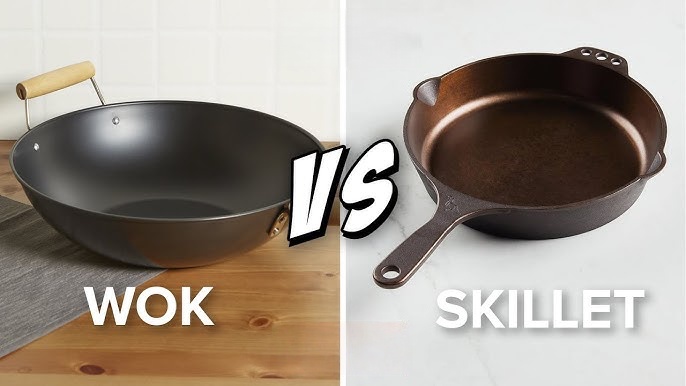
Choosing between a flat pan (skillet) and a traditional wok is one of the most common dilemmas for home cooks. While both can produce a meal, they operate on different thermal principles. Understanding these differences is the key to achieving professional results in a home kitchen.

What It Is Used For: The Core Functional Difference
A wok is designed for high-heat, rapid-motion cooking. Its deep, sloped sides create distinct thermal zones: a searing “hot spot” at the base and cooler peripheral walls for resting ingredients. This geometry is essential for “tossing,” which aerates the food and helps develop wok hei (the “breath of the wok”).
A flat pan (such as a stainless steel or cast iron skillet) is designed for maximum surface-to-heat contact. It excels at searing, browning, and shallow frying where consistent, even contact with the heat source is required. While you can stir-fry in a skillet, the vertical or slightly flared sides make tossing difficult, often leading to “steaming” rather than “searing” if the pan is overfilled.
Material and Design Comparison
| Feature | Carbon Steel Wok | Stainless Steel Skillet | Cast Iron Skillet |
| Heat Response | Extremely Fast | Moderate | Slow |
| Heat Retention | Low | Moderate | Very High |
| Cooking Surface | Concave (Small Base) | Flat (Wide Base) | Flat (Wide Base) |
| Weight | Lightweight (Easy to toss) | Moderate | Heavy (Hard to toss) |
| Maintenance | Requires Seasoning | Dishwasher Safe | Requires Seasoning |
Pros & Cons
The Wok
- Pros:
- Speed: Rapid heating and cooling allow for precise control over delicate ingredients.
- Capacity: The high sides prevent food from flying out during vigorous stirring.
- Versatility: Beyond stir-frying, it is excellent for deep-frying (uses less oil), steaming, and smoking.
- Cons:
- Stability: Round-bottom woks require a wok ring on most home stoves.
- Heat Source Dependency: Woks perform best on gas; they are significantly less efficient on electric or induction cooktops due to limited surface contact.
The Flat Pan (Skillet)
- Pros:
- Universal Compatibility: Works perfectly on gas, electric, and induction.
- Superior Searing: The wide flat base allows for browning large batches of meat simultaneously without crowding.
- Cons:
- Crowding Issues: Because the sides are shallow, moisture cannot escape as easily as in a wok, which can lead to watery stir-fries.
- Difficulty Tossing: High-speed flipping is nearly impossible without spilling, forcing you to use a spatula which can break delicate ingredients like tofu.
Who Should Buy Which?
Buy a Wok If:
- You have a powerful gas range.
- You prioritize authentic Chinese techniques and want to master how to control wok hei at home.
- You cook stir-fries at least 2–3 times a week.
- You prefer using a single vessel for deep frying and steaming.
Buy a Flat Pan If:
- You cook on an electric or induction stove.
- You want a multi-purpose tool that can also sear steaks, cook omelets, and make pan-sauces.
- You have limited storage space and need one pan to “do it all.”
Professional Maintenance Guide
Carbon Steel Wok Maintenance
- Initial Seasoning: New woks must be scrubbed to remove factory oil, then heated until the metal turns blue before applying a thin layer of high-smoke-point oil.
- Daily Cleaning: Use hot water and a soft brush. Avoid soap unless absolutely necessary, as it strips the “patina.”
- Storage: Always dry the wok on the stove over low heat to prevent rust. If you live in a humid climate, apply a microscopic layer of oil before storing.
Skillet Maintenance
- Stainless Steel: Use “Barkeeper’s Friend” to remove polymerized oil stains and keep the surface reflective.
- Cast Iron: Treat similarly to a wok—dry thoroughly and oil after every use to maintain its non-stick properties.
Common Mistakes When Choosing and Using
1. Using a Round-Bottom Wok on Electric Stoves
A round-bottom wok on a flat electric element only touches at one tiny point. The heat transfer is abysmal. If you have an electric stove, you must use a flat-bottom wok or a heavy skillet to ensure the stir fry temperature remains high enough to sear.
2. Overcrowding the Surface
In a flat pan, overcrowding leads to an immediate drop in temperature. This is the primary reason why your stir-fry turns watery. In a skillet, keep your meat in a single layer with space between pieces.
3. Choosing the Wrong Oil
Using extra virgin olive oil or butter for high-heat stir-frying will result in bitter, burnt flavors and excessive smoke. Always select the best oil for stir frying with a smoke point above 200°C (400°F), such as grapeseed, peanut, or refined soybean oil.
Scenario Differences: Restaurant vs. Home Kitchen
In a restaurant, a wok burner produces roughly 100,000–150,000 BTUs, creating a massive pillar of heat that licks the sides of the wok. In this environment, a flat pan would be inefficient and likely warp.
In a home kitchen, most gas burners produce 7,000–15,000 BTUs. Because the heat is lower, the wide base of a flat pan actually captures more of the burner’s total output than a wok does. For many home cooks on standard electric ranges, a heavy 12-inch skillet will actually produce a better sear than a cheap, thin wok.
When This Method Does NOT Work
- Small Portions: If you are cooking a single serving, a large 14-inch wok is overkill. The sauce will evaporate too quickly and burn before the food is cooked. Use a small skillet instead.
- High-Starch Ingredients: If you are making authentic Mapo Tofu, a wok is great for tossing, but if you are inexperienced, the tofu can easily break. A flat pan allows you to gently slide the tofu without aggressive flipping.
- Induction Cooktops: Traditional carbon steel woks do not work on induction unless they have a large, perfectly flat bottom. If you have induction, a high-quality tri-ply stainless steel skillet is almost always the superior choice for heat distribution.
FAQ
Q: Can I get “Wok Hei” in a flat pan?
A: It is significantly harder because the flat pan doesn’t allow for the same level of aeration. However, you can mimic the flavor by searing the meat in very small batches until deeply browned and using a stir fry sauce ratio formula that includes a touch of toasted sesame oil added at the very end.
Q: What is the best size for a home wok?
A: A 14-inch (35cm) flat-bottom carbon steel wok is the standard recommendation for a family of four.
Q: Do I need to velvet meat if I’m using a flat pan?
A: Yes. Regardless of the pan, learning how to velvet chicken is essential for maintaining moisture, especially in the dry heat of a skillet.


Leave a Reply