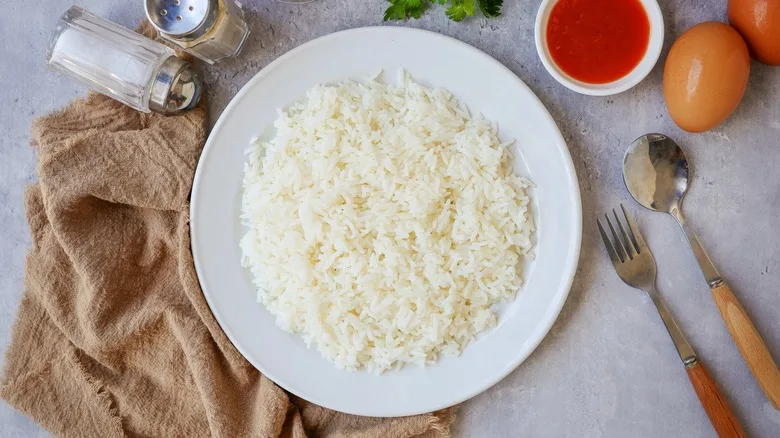
Achieving the distinct, individual grain texture of restaurant-quality fried rice requires more than just high heat; it requires a specific physiological state of the grain known as starch retrogradation. Freshly cooked rice is high in surface moisture and contains “solubilized” amylopectin, which creates a sticky, cohesive mass when agitated in a wok. In contrast, day-old rice—rice that has been cooked and refrigerated for 12 to 24 hours—undergoes structural changes that make it the superior substrate for stir-frying.
Why It Works: The Science of Starch Retrogradation
The primary reason day-old rice performs better in a stir-fry is a process called retrogradation. When rice is first cooked, the starch granules absorb water and swell (gelatinization), becoming soft and sticky. As the rice cools, particularly in the low-humidity environment of a refrigerator, the amylose and amylopectin chains begin to re-align into a more rigid, crystalline structure.
- Moisture Migration: During refrigeration, moisture moves from the surface into the center of the grain, while some evaporates entirely. This results in a dry exterior that prevents grains from clumping.
- Structural Integrity: Retrograded starch is firmer. This allows the rice to withstand the mechanical stress of a spatula without breaking or turning into a mash.
- The Maillard Reaction: Drier grains allow the best oil for stir frying to coat each individual piece. This ensures that the high heat of the wok (typically 375–450°F or 190–230°C) triggers the Maillard reaction on the grain’s surface rather than just steaming the rice in its own residual moisture.
Controlled Variable Explanation
To achieve consistent results, several variables must be controlled during the “aging” process.
| Variable | Target Parameter | Rationale |
| Initial Hydration | 1:1 to 1:1.25 (Rice to Water) | Excess water during the initial boil creates a core that is too soft to retrograde effectively. |
| Cooling Method | Spread thin on a tray for 30 mins | Rapidly reducing temperature prevents “carry-over” steaming which traps excess surface moisture. |
| Storage Temperature | 35°F – 40°F (1.6°C – 4.4°C) | Standard refrigerator temperatures accelerate the crystallization of starch molecules. |
| Storage Duration | 12 – 24 hours | Under 12 hours may leave the core too moist; over 48 hours can lead to excessive “staling” and hardness. |
Step-by-Step Technique: Preparing Rice for Stir-Fry
- Selection: Use long-grain varieties like Jasmine. Its higher amylose content compared to short-grain rice makes it less prone to stickiness.
- Rinsing: Wash rice 3–5 times until the water runs clear. Removing surface starch is a critical first step in preventing clumping later.
- Cooking: Use a slightly lower water ratio than for steamed rice. If you typically use a 1:1.5 ratio, drop to 1:1.2 for fried rice. You can cook jasmine rice perfectly using a rice cooker or a cast iron pot.
- The Spread: Immediately after cooking, spread the rice onto a large rimmed baking sheet. Fluff it with a fork to break up large clumps while it is still warm.
- The Chill: Once it reaches room temperature, cover it loosely and refrigerate. After 12 hours, the grains will be firm and separate easily with your fingers.
Professional Tips for Technique Mastery
- Hand-Separation: Before the rice even touches the wok, reach in and break up any remaining clumps by hand. If you wait until the rice is in the pan, the heat will soften the starch, making it harder to separate without smashing the grains.
- The Oil Barrier: For an extra “restaurant-style” finish, toss the cold rice with a tablespoon of neutral oil or homemade lard before frying. This creates a physical barrier that prevents the grains from re-absorbing sauce too quickly.
- Wok Hei Control: When stir-frying, ensure your wok is at the “breath of the wok” stage (wisps of smoke) before adding the rice. This requires understanding how to control wok hei at home to ensure the rice is seared, not stewed.
Troubleshooting & Common Mistakes
Why Your Stir-Fry Turns Watery
If your finished dish is soggy despite using day-old rice, the issue is likely overcrowding or ingredient sequencing. Adding too many wet vegetables at once drops the wok temperature, causing the rice to steam. If you notice this, consult our guide on why your stir-fry turns watery.
The “Hard Core” Issue
If the rice feels like “pebbles” even after stir-frying, the rice was likely undercooked during the initial boiling phase. Starch retrogradation makes rice firmer, but it cannot fix a grain that never gelatinized in the center.
Restaurant vs. Home Comparison
| Variable | Restaurant Environment | Home Kitchen Environment |
| Heat Source | 80,000–120,000 BTU Wok Burners | 10,000–18,000 BTU Gas/Electric Stove |
| Rice Volume | Prepared in massive 20+ cup batches | Typically 2–4 cups |
| Moisture Control | High-velocity fans and industrial coolers | Standard home refrigerator |
| Recovery Time | Instant heat recovery after adding rice | 30–60 second lag to return to searing temp |
Limitation & Safety Disclosure
- Bacillus Cereus Risk: Rice is a high-risk food for Bacillus cereus, a bacterium that produces heat-resistant toxins. Rice must be cooled to below 41°F (5°C) within two hours of cooking to remain safe for consumption. Never leave rice sitting out overnight on the counter.
- This technique does NOT apply when: Making Risotto or Paella, where the goal is to utilize the starch to create a creamy or bonded texture.
- Electric Stove Limitation: Home electric coils lack the “wrap-around” heat of gas. For best results on electric, use a flat-bottom wok and fry in smaller batches (2 cups max) to maintain the temperature.
Sources & Standards Referenced
- USDA Food Safety and Inspection Service – Cooking for Groups: Voluntary Food Safety Guide
- Harvard T.H. Chan School of Public Health – The Nutrition Source: Rice
- FDA Food Code 2022 – Time and Temperature Control for Food Safety
FAQ
Q: Can I use freshly cooked rice if I’m in a rush?
A: You can, but you must spread it on a tray and put it in front of a fan for 20 minutes to remove as much surface steam as possible. It will still be “softer” than day-old rice.
Q: Does the type of rice matter?
A: Yes. Sticky rice (Glutinous rice) will never achieve individual grain separation regardless of how long you refrigerate it. Use Jasmine or Basmati.
Q: Why is my refrigerated rice so hard?
A: That is the starch retrograding! It is supposed to be hard. Once it hits the hot oil in the wok, the heat will “reset” the grains to a tender (but not mushy) state.






Leave a Reply