Hey there! Lin here.

If you grew up in a Chinese household like I did, the smell of Chinese Red Sugar (Hong Tang) probably brings back very specific memories. For me, it’s the scent of my mom’s kitchen on a cold winter day, a pot of ginger tea bubbling away on the stove. It wasn’t just a treat; it was the go-to remedy for everything from period cramps to the common cold.
Let’s be real—to the untrained eye, it just looks like brown sugar. But in the world of Chinese cuisine and Traditional Chinese Medicine (TCM), Hong Tang (红糖) is in a league of its own. It’s not just an ingredient; it’s practically a nutritional supplement.
Today, I’m taking you beyond the “sweetness” to understand why this unrefined sugar is a staple in my pantry, how it differs from the Western stuff, and how you can use it to level up your cooking (and maybe even your health).
What is Chinese Red Sugar?
Chinese red sugar (红糖) is an unrefined cane sugar that gets its deep, reddish-brown hue and distinctive mineral flavor from the natural molasses remaining in the product after cooking.
Here is the science bit (my culinary school side coming out!): Unlike white sugar, which is heavily processed and stripped of its natural minerals, Chinese red sugar retains the natural nutrients of the sugarcane juice. The juice is pressed, filtered, and boiled down until it crystallizes. It’s not separated from the molasses—it is the molasses and sugar combined.
This is different from Western brown sugar. In the West, “brown sugar” is usually just refined white sugar that has had molasses added back into it. This makes the texture consistent, but it lacks the depth of flavor and the trace minerals—like iron, calcium, and magnesium—found in the traditional Chinese variety.

Flavor and Texture: The Chef’s Instinct
When you open a package of high-quality red sugar, take a sniff. It shouldn’t just smell sweet; it should smell toasty, almost like caramel or even slightly smoky.
Flavor-wise, it’s less cloyingly sweet than white sugar. It has a complex, robust profile that adds a savory depth to dishes. This makes it perfect not just for desserts, but for balancing the saltiness in soy-sauce-heavy braises.
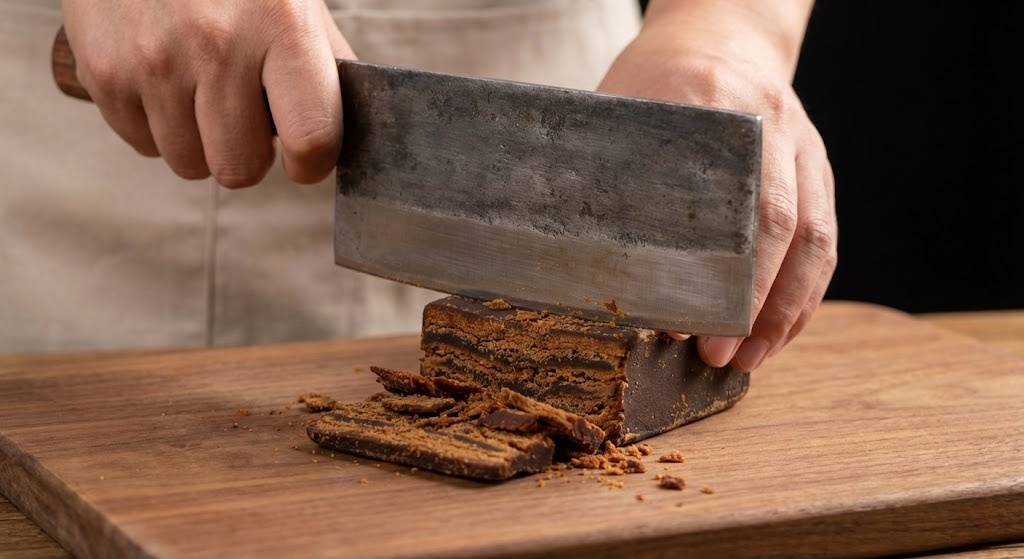
Texture Note: It comes in different forms. You might find it as a solid brick (which you have to shave or chop—fun, right?), a powder, or in a moist, sandy form. The blocks are often the least processed and most prized.
Health Benefits: The “Woman’s Herb”
In Traditional Chinese Medicine (TCM), food is medicine. Red sugar is considered “warming” (yang) and nourishing.
It is particularly famous for its role in women’s health. It is believed to nourish the blood and improve circulation, making it a critical ingredient for postpartum recovery and menstrual health.
- Postpartum: It’s standard protocol for new mothers to drink red sugar and ginger tea to “expel cold” and replenish energy lost during childbirth.
- Period Pain: Many of my friends swear by a hot cup of red sugar water to ease cramps.
- Energy: It is used to “boost Qi” (vital energy).
Note: While it contains trace minerals like iron, remember that it is still sugar! Use it mindfully.

How to Use Chinese Red Sugar in Your Kitchen
You can use Chinese red sugar in almost any recipe that calls for brown sugar, but here are the places where it truly shines:
1. The Secret to the “Red” in Red Braised Pork
You know that glossy, mahogany sheen on a perfect Braised Pork Belly? That often comes from caramelizing rock sugar or red sugar. The red sugar adds a depth of color that soy sauce alone can’t achieve.
2. Balancing Sour Flavors
I always use a touch of sugar to round out vinegar-heavy dishes. If you are making Sweet and Sour Pork Ribs, try using red sugar instead of white. The caramel notes play beautifully with the vinegar.
3. Traditional Desserts & Soups
This is non-negotiable! For desserts like Chinese Date Cake (Zao Gao), red sugar provides the signature dark color and moisture. It’s also essential for sweet soups; I love stirring it into a warm bowl of Red Bean and Black Rice Porridge on a rainy morning.
4. Sweet Glazes
The molasses content makes it fantastic for sticky glazes. Try swapping it into the sauce for Classic Sweet and Sour Pork for a richer, less artificial taste.
5. Sticky Rice Treats
If you are making Yellow Millet Sticky Rice Cake, sprinkling some red sugar on top adds a lovely crunch and deep sweetness that white sugar just can’t match.
Lin’s “No Secrets” Tips for Buying and Storing
Red vs. Black Sugar: You might see packages labeled “Black Sugar” (Hei Tang – 黑糖). This is essentially a darker, more caramelized version of red sugar, cooked longer to concentrate the flavors and minerals. It’s more expensive and often used for milk teas or premium desserts.
The “Brick” Problem: If you buy the block form, it will be hard. Don’t panic. You can microwave it for a few seconds (literally 10-15 seconds) to soften it enough to cut, or just grate what you need with a knife.
Storage: Like any brown sugar, it loves to turn into a rock if exposed to air. Keep it in an airtight container. If it dries out, toss a slice of apple or a piece of bread in the jar overnight—it works like magic to rehydrate the sugar!
Authoritative References
- Healthline: Brown Sugar vs. White Sugar: What’s the Difference? – Explains the nutritional differences between refined and unrefined sugars.
- Tian Wei Signature: Why Do Mothers Drink Confinement Red Date Tea? – Details the TCM perspective on red sugar and red dates for postpartum recovery.
- PubMed (NIH): Antioxidant activity and nutritional characteristics of minimally refined brown sugar – Scientific analysis of the phytochemicals found in unrefined cane sugar.
Happy cooking, and stay sweet! – Lin






Leave a Reply