The Frustration of the Wrong Tool
You are standing over a blazing hot pan, ready to execute a perfect meal, but your plastic spatula is starting to wilt against the heat. Maybe you’re struggling to flip delicate slices of meat, or your flat “pancake” turner simply can’t reach the curved edges of your pan, leaving half your garlic to burn while the rest stays raw. This is the most common hurdle for home cooks—using a tool that fights the physics of the wok rather than helping it.

The Quick Answer
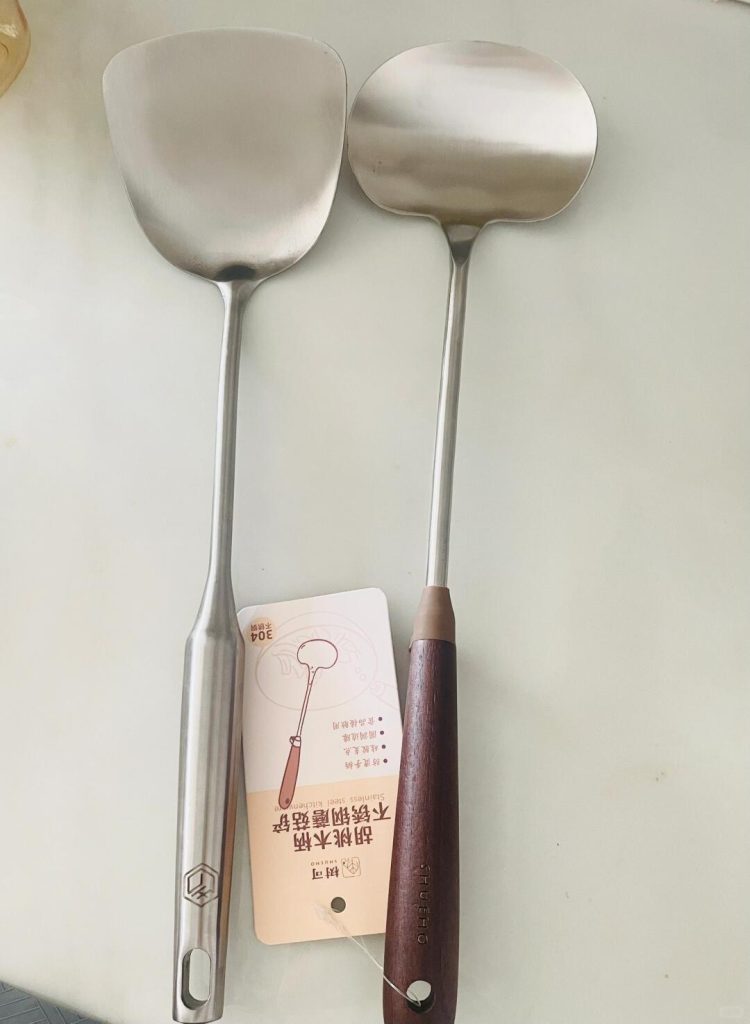
For a traditional carbon steel or cast iron wok, the stainless steel wok spatula (Chuan) is the gold standard because its curved edge matches the pan’s contour. If you are cooking on a non-stick surface, a high-heat silicone spatula with a reinforced metal core is the only choice that offers both safety and the structural integrity needed to toss heavy ingredients.
Why the Right Spatula Design Works
The effectiveness of a stir-fry spatula comes down to three mechanics: curvature, shovel-depth, and heat displacement.
- Curvature: A proper wok spatula has a slight crescent moon shape at the leading edge, allowing it to “sweep” the entire surface of a curved wok in one motion.
- Shovel-Depth: Unlike flat Western turners, a Chinese Chuan has a slight lip, which allows you to “scoop and toss” rather than just “push”.
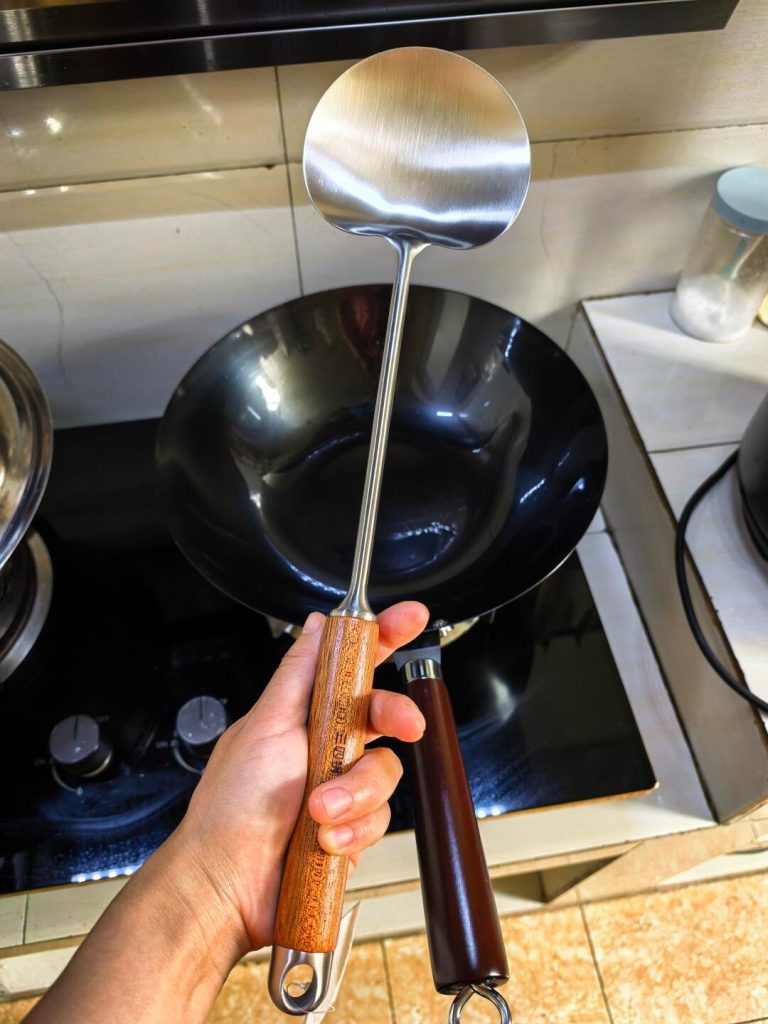
- Heat Displacement: Long handles (usually 14–16 inches) are essential for keeping your hands away from the rising steam and oil splashes produced by high-heat cooking.
Real Kitchen Insights
In my experience, what most beginners don’t realize is that the spatula is not just for moving food; it is a sensory feedback device. In a restaurant kitchen, we listen for the “shink-shink” sound of a metal spatula against a seasoned wok—it tells us exactly how dry the surface is and whether the sauce is beginning to caramelize. If you are still deciding between a flat pan vs wok for stir fry, remember that your tool must match your pan’s geometry.
Essential Materials and Substitutes
Choosing the right material depends entirely on your cookware:
- Stainless Steel: The pro choice for carbon steel. It is indestructible and thin enough to get under delicate eggs.
- Silicone: The best substitute for non-stick pans. Ensure it is rated for at least 450°F (230°C).
- Wood/Bamboo: A classic Western-friendly alternative. It’s gentle on pans but often too thick to slide under thinly sliced meat. Before you start, make sure you know how to slice meat for stir fry to ensure your spatula can handle the pieces easily.
The Strategy of Spatula Selection
When shopping, don’t just look at the head of the spatula; look at the handle logic.
- Length: For home stoves, a 14-inch handle is the “sweet spot.” Anything longer is unwieldy; anything shorter leads to burns.
- Angulation: The head should meet the handle at an angle that allows your wrist to stay neutral while the spatula lies flat against the bottom of the pan.
- Weight: It should feel balanced. If the head is too heavy, you will tire out before the best oil for stir frying even reaches its smoke point.
How to Use Your Spatula Like a Pro
- The Sweep: Place the spatula at the 12 o’clock position of the pan and sweep down to 6 o’clock, following the curve.
- The Flip: Use the “shovel” action to get under the food, lift, and turn it over in the air. You should hear a distinct hiss as the cold side of the food hits the hot metal.
- The Scrape: Use the leading edge to keep the bottom of the pan clear, preventing a build-up of soy sauce or starches that can cause sticking.
Common Spatula Mistakes + Fixes
| Mistake | Why it happens | The Professional Fix |
|---|---|---|
| Using Metal on Non-stick | Habit from watching pros | Switch to reinforced silicone to avoid eating Teflon. |
| Short-Handle Spatulas | Designed for small pans | Use at least a 14-inch handle to avoid oil splatter burns. |
| Pushing instead of Scooping | Using a flat pancake turner | Tilt the tool to use the corner or buy a curved wok spatula. |
| Ignoring the “Click” | Not checking for debris | If the spatula feels “sticky” on the pan, add a splash of water or wine. |
| Melting Plastic | Using “nylon” tools | Only use silicone or metal; nylon melts at stir-fry temps. |
导出到 Google 表格
Pro Tips for Better Tossing
- The Wood-to-Metal Transition: If you’ve finally mastered how to season a wok properly, reward yourself by switching from a wooden spoon to a stainless steel Chuan. The precision is life-changing.
- Clean as You Go: Dip your spatula in a bowl of warm water between different stages of cooking to prevent old sauce from burning onto the tool.
- Angle of Attack: Keep the spatula at a 30-degree angle to the pan surface for the smoothest glide.
Material Variations
- Traditional Iron: Heavy and requires seasoning, but offers the most authentic feel.
- Hand-Forged Steel: Features a slightly textured surface that helps “grip” noodles during a toss.
- Integrated Silicone: One-piece designs are the most hygienic as there are no seams for old food to hide.
Spatula-Test Recipe: Hand-Torn Cabbage
This simple dish is the perfect way to test your spatula’s ability to move high-volume, light ingredients. You can find the full technique in my guide to Hand-Torn Cabbage.
- Prep: Tear half a head of cabbage into 2-inch pieces.
- Heat: High heat with 2 tablespoons of neutral oil.
- Action: Use your spatula to constantly sweep the cabbage from the bottom to the top.
- Sensory Signal: When the cabbage edges look charred but the stems are still crisp, it’s done.
FAQ
1. Can I use a regular wooden spoon for stir fry? You can, but it’s difficult. Spoons move food around, while spatulas flip and aerate it, which is essential for “wok hei.”
2. Why did my silicone spatula melt? Likely it was actually nylon, or it was left resting against the edge of a hot pan. Always check the heat rating.
3. What length spatula is best for a 12-inch skillet? A 12 to 14-inch spatula is perfect. Anything longer will feel top-heavy in a smaller pan.
4. How do I clean a stainless steel wok spatula? Treat it like your wok. Hot water and a soft sponge. If it’s high-quality stainless, it can go in the dishwasher, but hand-drying prevents spotting.
5. Do I need a different spatula for fried rice? A metal spatula is actually better for rice because the thin edge can “cut” through clumps of Jasmine rice without mashing the grains.










Leave a Reply